Watch a match with a beginner and you’ll hear the same question within about ten minutes: “wait, what does that guy actually do?” Football positions look simple from the outside — eleven players, one ball — until you try to explain why a “false nine” barely plays near goal, or why a modern full-back sometimes ends up standing in midfield.
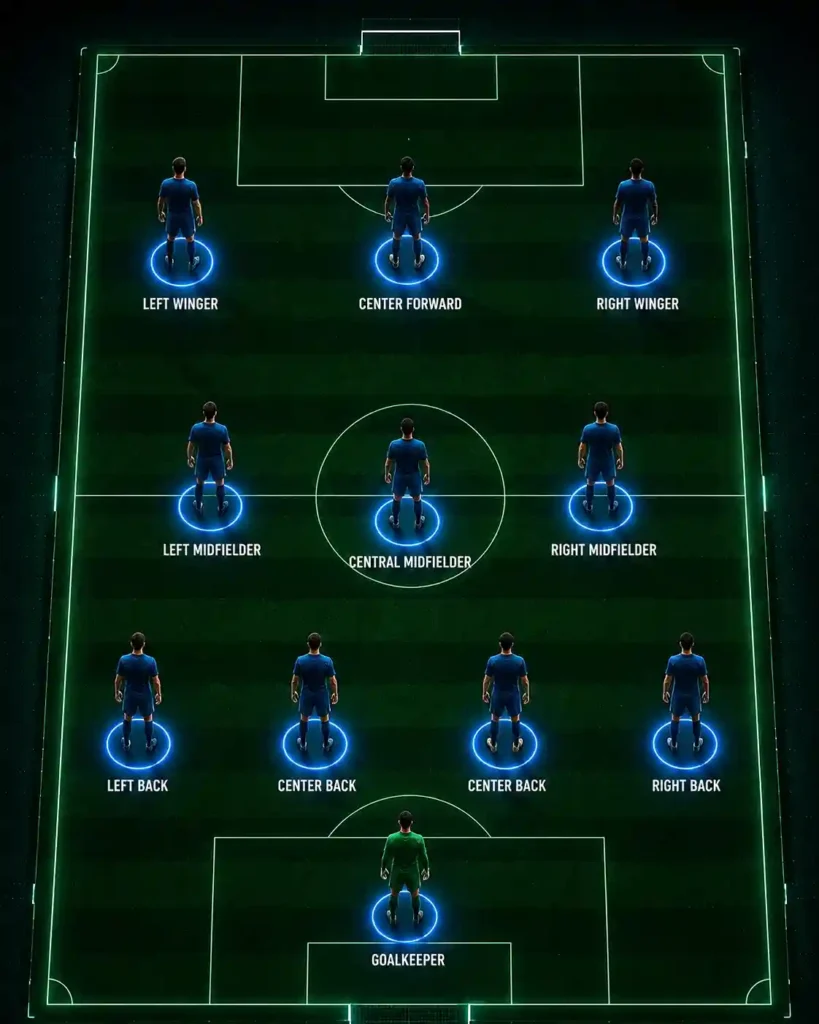
Football has four broad position groups — goalkeeper, defenders, midfielders, and attackers — each with several specialized roles inside them (center-back, full-back, defensive midfielder, winger, striker, and so on). A team’s formation, like 4-3-3 or 4-4-2, simply describes how many players occupy each group and where they line up relative to each other.
Key Takeaways
- Every outfield position falls under one of four groups: defense, midfield, attack, plus the goalkeeper as a category of one.
- Formation numbers (4-3-3, 4-2-3-1, 3-5-2) describe defenders–midfielders–attackers, read from the back of the team forward.
- Modern football has blurred old position boundaries — full-backs attack, strikers drop deep, and center-backs are now expected to pass like midfielders.
- The false nine and inverted full-back are two of the most common “hybrid” roles confusing newer fans today.
The Goalkeeper
The only player allowed to use their hands, and only inside their own penalty area. Beyond shot-stopping, modern goalkeepers are increasingly judged on their passing and distribution — many top teams effectively use their keeper as an extra outfield passer to build attacks from the back, a shift largely credited to Pep Guardiola’s influence on the position over the last decade.
Defenders
Center-Back (CB)
The core of any defense, usually playing in pairs or as part of a back three. Their main job is stopping opposition attackers from scoring — winning aerial duels, blocking shots, and organizing the defensive line to catch opponents offside. Modern center-backs are also expected to be comfortable passing the ball out from the back under pressure, not just defending.
Full-Back / Wing-Back (FB / WB)
Full-backs defend the wide areas but have become one of the most transformed positions in modern football — many now push forward as auxiliary attackers, overlapping wingers or even tucking into midfield during possession (an “inverted full-back,” a role popularized by teams like Manchester City). A wing-back is essentially a more attack-minded version of the same role, common in formations with three center-backs, since it requires covering more ground with less central defensive cover behind them.
Sweeper (Libero) — Mostly Historical
A once-common role that sat behind the main defensive line, free to cover any gap or launch attacks. It’s rare in the modern game but historically iconic — Franz Beckenbauer’s redefinition of the sweeper role in the 1970s is part of why he’s remembered as one of the greatest defenders ever.
Midfielders
Defensive Midfielder (DM / CDM)
Sits just in front of the back line, breaking up opposition attacks and shielding the defense. Think of them as the team’s first line of protection once the ball is lost — winning tackles, intercepting passes, and often starting attacks with a simple, secure pass forward.
Central Midfielder (CM)
The engine room. Central midfielders do a bit of everything — supporting the defense, controlling possession, and linking play toward the attack. Some lean more defensive, others more creative, depending on the team’s system.
Attacking Midfielder (AM / CAM)
Plays just behind the striker(s), focused on creating chances — through-balls, key passes, and often goals themselves. This is usually the most creatively gifted player on the pitch, tasked with unlocking a defense that the rest of the team can’t break down alone.
Wide Midfielder
Similar to a winger but with more defensive responsibility, typically used in a 4-4-2 or similar formation rather than a system built around out-and-out wingers.
Attackers
Winger
Plays wide in attack, relying on pace and dribbling to get past full-backs and deliver crosses or cut inside to shoot. Modern wingers, especially “inverted” wingers who play on the opposite side to their strong foot, often cut inside to shoot rather than cross — a tactical shift closely associated with players like Arjen Robben and, more recently, wide forwards across the modern game.
Striker / Center-Forward (CF / ST)
The player primarily responsible for scoring goals, typically the furthest player forward. Strikers range from out-and-out poachers who thrive in the penalty box to more mobile forwards who drop deep to link play.
False Nine
This is the role that confuses newer fans the most. A false nine lines up as the central striker on paper but deliberately drops into midfield to receive the ball, dragging opposition center-backs out of position and creating space for wingers or midfielders to run into. It doesn’t behave like a traditional striker at all — the position’s most famous modern example is Lionel Messi’s role under Pep Guardiola at Barcelona, where a nominal “striker” often had fewer touches inside the penalty box than his own midfielders.
Position, Role, and Primary Job
| Position | Common Abbreviation | Primary Job |
|---|---|---|
| Goalkeeper | GK | Stop shots, distribute the ball, organize the defense. |
| Center-Back | CB | Stop attackers, win duels, build play from the back. |
| Full-Back / Wing-Back | FB / WB | Defend wide areas, support attacks down the flank. |
| Defensive Midfielder | DM / CDM | Shield the defense, win the ball back, start attacks. |
| Central Midfielder | CM | Balance defense and attack, control possession. |
| Attacking Midfielder | AM / CAM | Create scoring chances, play the final pass. |
| Winger | LW / RW | Beat defenders wide, cross or cut inside to shoot. |
| Striker / Center-Forward | CF / ST | Score goals, hold up play, finish chances. |
| False Nine | — | Drop deep as a “striker” to create space and chances for others. |
How Formations Tie These Positions Together
A formation like 4-3-3 simply means 4 defenders, 3 midfielders, and 3 attackers, read from the goalkeeper outward (the goalkeeper is never counted in the number). A 4-2-3-1 breaks the midfield into two lines — two defensive midfielders behind three attacking midfielders/wingers, supporting a single central striker. A 3-5-2 uses three center-backs and wing-backs to provide width instead of traditional full-backs, with two strikers up front.
None of these formations are fixed in real time — a modern team might defend in one shape and attack in a completely different one, which is part of why positions have become more fluid than the old rigid numbering system suggests.