
Every outfield position rewards doing the same thing your teammates do, just better. Goalkeeping doesn’t work that way — it’s an entirely different sport bolted onto the side of football, with its own footwork, its own rulebook, and its own way of thinking about pressure. That’s exactly why so many beginners find it confusing to know where to even start.
Becoming a good goalkeeper as a beginner means building four things in order: solid positioning and ready stance, reliable handling technique (the W-catch and smothering), basic diving mechanics, and the mental resilience to reset instantly after a mistake. Understanding the position’s specific rules — like the time limit on holding the ball — matters just as much as physical technique.
Key Takeaways
- Positioning comes before diving. A goalkeeper who’s standing in the right spot rarely needs a spectacular save — most great saves are actually the result of good positioning making an easy save look hard.
- The “6-second rule” is now an 8-second rule. As of the 2025/26 Laws of the Game, goalkeepers have 8 seconds to release the ball, and the punishment for holding it too long is now a corner kick, not an indirect free kick.
- Goalkeepers need four skill categories: technical (handling, diving, footwork), physical (agility, explosive power, core strength), tactical (positioning, reading the game), and mental (focus, confidence, quick recovery from mistakes).
- Mistakes are part of the position — even elite goalkeepers focus heavily on mental training specifically because a single error is often more visible than in any other role on the pitch.
Suggested Reads:
What Skills Do Goalkeepers Need?
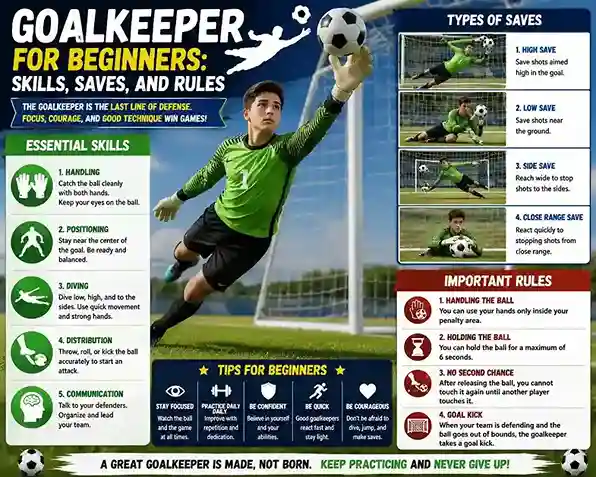
Goalkeeping skill breaks down into four connected areas, and beginners who only focus on one (usually diving, since it looks the most impressive) tend to plateau quickly.
| Skill Category | What It Includes | Why It Matters |
|---|---|---|
| Technical | Catching (W-shape and basket catch), diving mechanics, footwork, kicking/distribution | The physical foundation every save and pass is built on |
| Physical | Explosive power, agility, core strength, quick recovery after diving | Determines how far, how fast, and how safely a keeper can move |
| Tactical | Positioning, angle-cutting, reading attacker body language, organizing the defense | Reduces how often a spectacular save is even needed |
| Mental | Focus, confidence, resilience after conceding, staying present under pressure | The difference between a keeper who recovers instantly and one who spirals after a mistake |
How to Be Good at Goalkeeper for Beginners
For anyone starting out, the order you build these skills in matters more than trying to do everything at once.
Master Your Ready Stance and Positioning First
Before diving or catching technique, get comfortable with a balanced stance: weight evenly spread on both feet, knees slightly bent, hands at roughly hip height so you’re equally ready for a low or high shot. Beginners should practice imagining a straight line from the ball to the center of the goal and staying on it, adjusting a few steps off the line as the ball moves — this single habit does more to prevent goals than any dive ever will.
Learn Proper Catching Technique
Two techniques form the foundation of safe handling:
- The “W” hand shape — thumbs and index fingers close together behind the ball, forming a rough “W,” used for shots around chest height and above.
- The basket catch — arms and hands forming a scoop shape, used for lower shots, bringing the ball into the body rather than just the hands to avoid rebounds.
Build Basic Diving Mechanics
Diving looks like the most dramatic goalkeeping skill, but it’s actually used less often than footwork, handling, and positioning. When it is needed, three fundamentals matter most:
- Step first — diving to the left starts with a step off the left foot, generating power from a partial lunge rather than a standing jump.
- Lead with the shoulders — the body should move toward the ball first, with the hands following, rather than just reaching with the arms alone.
- Land safely on the hip and shoulder — never the elbow or knee directly, which causes painful, avoidable injuries for beginners still building the habit.
Practice Distribution Early, Not as an Afterthought
Modern goalkeeping expects accurate distribution by both hand and foot — short throws for quick build-up play, and longer kicks for clearances or counter-attacks. Beginners often treat this as a secondary skill, but at every level above true beginner, weak distribution becomes a real, exploitable weakness.
Train Communication From Day One
A goalkeeper sees the whole pitch in a way no other player does, which means organizing the defense — calling out attackers, directing markers at corners, warning about pressure from behind — is part of the job, not an optional extra. This is a skill most beginners underdevelop simply because it feels awkward at first.
How to Save a Goal: The Actual Technique
Saving a shot isn’t one single skill — it’s a sequence, and most goals conceded by beginners come from a breakdown at an earlier stage in that sequence, not necessarily the final dive.
- Get into position before the shot — cut down the shooting angle by positioning yourself on the imaginary line between the ball and the center of the goal.
- Stay balanced and still as the shooter approaches — a goalkeeper who is still moving or off-balance the instant before a shot is taken is already reacting from a weaker position.
- Read the shooter’s body shape — the angle of the standing foot and hips often signals shot direction before the ball is even struck.
- Commit fully once you decide — hesitation is one of the most common beginner mistakes; a fully committed dive to the wrong side is often more effective than a half-hearted attempt in the right direction.
- Catch and hold where possible; parry only when necessary — securing the ball avoids a dangerous rebound, but if a clean catch isn’t possible, parry it away from goal and away from onrushing attackers, not just anywhere.
- For 1v1 situations specifically — time an explosive run off the line to shrink the attacker’s shooting angle and space, staying big rather than diving early, forcing the attacker to make a rushed decision.
What Is the “6-Second” Goalkeeper Rule?
This is one of the most-searched goalkeeper rule questions, and the honest answer requires an update most fans haven’t caught up with yet: the 6-second rule technically no longer exists. As of the 2025/26 Laws of the Game, IFAB extended the time limit to 8 seconds and changed the punishment.
| Old “6-Second Rule” | Current Rule (2025/26 onward) |
|---|---|
| Time limit to release the ball 6 seconds |
Time limit to release the ball 8 seconds |
| Countdown signal None |
Countdown signal Referee raises a hand for the final 5 seconds |
| Punishment Indirect free kick inside the box |
Punishment Corner kick to the opposing team |
The change happened because the old punishment was so severe — an indirect free kick from inside a crowded penalty area — that referees almost never actually enforced it in practice. A corner kick is a far more realistic, consistently applied deterrent, which is exactly why IFAB made the switch after positive trial results across hundreds of matches. For the full breakdown of every goalkeeper-specific law, see our complete goalkeeper rules guide.
Age-by-Age Development Tips for Young Goalkeepers
| Age Group | Primary Focus |
|---|---|
| Under 10 | Getting comfortable catching and not being afraid of the ball; trying multiple positions, not just goalkeeper. |
| 11–13 | Learning basic diving mechanics, starting to play the ball out with feet, basic communication. |
| 14–16 | Deeper tactical understanding, mental resilience training, refining all technical skills together. |
Keeping training varied and enjoyable at younger ages matters more than repetitive, overly serious drilling — young goalkeepers who enjoy the position are far more likely to stick with it long enough to actually develop.
Common Beginner Mistakes
- Standing too close to the goal line, which gives shooters a bigger target instead of a cut-down angle.
- Reaching with straight arms instead of bringing the ball into the body, causing avoidable rebounds and spilled catches.
- Hesitating during 1v1 situations, giving the attacker time to pick a spot rather than forcing a rushed decision.
- Landing on the elbow or knee during dives, a common beginner injury risk that proper technique training prevents.
- Neglecting distribution and communication in favor of only practicing shot-stopping and diving.
Essential Equipment for Beginners
- Goalkeeper gloves — proper grip and protection; fit matters more than brand at a beginner level.
- Long-sleeved jersey — protects the arms and elbows during dives.
- Well-fitted shin guards that extend down toward the ankle.
- Cleats with reliable grip suited to the training surface.
- Optional extras as skill develops: knee pads, turf cleats for artificial surfaces, and finger protection to prevent hyperextension.
Frequently Asked Questions
How can beginners get good at goalkeeper quickly?
Focus on positioning and ready stance first, since good positioning prevents more goals than diving ever will. Build catching technique (the W-shape and basket catch) and basic diving mechanics next, then layer in distribution, communication, and mental resilience as those fundamentals become automatic.
What is the 6-second goalkeeper rule?
The traditional “6-second rule” allowed a goalkeeper to hold the ball for up to 6 seconds before being penalized with an indirect free kick. As of the 2025/26 Laws of the Game, this has been extended to 8 seconds, with a corner kick now awarded to the opposing team for a violation instead.
How do you actually save a goal?
Effective saving is a sequence: cut the shooting angle through positioning before the shot, stay balanced as the shooter approaches, read their body shape for clues on direction, commit fully once a decision is made, and catch or parry the ball safely away from danger.
What skills do goalkeepers need most?
Four categories matter: technical skills (handling, diving, footwork, distribution), physical attributes (agility, explosive power, core strength), tactical understanding (positioning, reading the game), and mental resilience (focus, confidence, recovering quickly after a mistake).
Is diving the most important goalkeeping skill?
No — despite being the most visually dramatic, diving is actually used less frequently than positioning, footwork, and handling. Many of the best saves are the result of a goalkeeper being in the correct position, making a difficult shot look routine.