
Nearly every kid who’s ever kicked a ball has imagined it: the roar of a crowd, a shirt with their name on the back, a moment that changes their life. Almost none of them are told, clearly and honestly, just how narrow that path actually is — or exactly what it takes to walk it anyway.
Becoming a professional footballer requires joining a structured academy pathway (usually between ages 8–12), surviving repeated competitive cuts through your teenage years, earning a scholarship or apprenticeship contract around 16, and securing a full professional deal — typically around 17–18 — before breaking into a first team through loans or first-team minutes. Globally, only around 0.04–0.05% of all players who take up the sport ever reach professional level, based on FIFA’s own player census data.
Key Takeaways
- The realistic odds of turning pro are somewhere between 1 in 200 and 1 in several thousand, depending on whether you’re already inside an elite academy or starting from grassroots football.
- Ages 12–16 are the biggest filter — this is when most academy players are released, as physical development and tactical understanding separate from raw childhood talent.
- Scouts assess four core areas: technical ability, physical attributes, tactical understanding, and psychological/social maturity — not just skill on the ball.
- Education and a backup plan aren’t optional extras — even top academies now build them directly into a player’s development program, because the overwhelming majority of academy players won’t turn professional.
- There are multiple pathways beyond the traditional academy route, including college soccer, non-league football, and being scouted at a later age abroad.

Suggested Reads:
The Real Odds of Becoming a Professional Footballer
This is the part most youth academies and private coaching programs don’t lead with, but it matters enormously for setting realistic expectations. According to FIFA’s own global player census, there are roughly 265 million people playing football worldwide, but only around 113,000–130,000 of them are registered professionals — a rate of somewhere between 0.04% and 0.05%, or roughly 1 in every 2,000 to 2,500 players.
Within elite academy systems specifically, the odds improve — but only somewhat. Research on English academies has found that a nine-year-old signed to a professional club academy has roughly a 1 in 200 chance of eventually turning professional. Separate reporting on the Premier League’s academy system has found that less than 1% of academy players are ultimately offered a professional contract, with most released by age 18.
| Stage | Estimated Odds of Reaching Full Professional Level |
|---|---|
| Any child who plays football recreationally | ~0.04%–0.05% (FIFA global player data) |
| Signed to a professional academy at age 9 | ~1 in 200 |
| Teenage academy player (any level) | ~1% (Essex University study) |
| Academy player at a Premier League club specifically | Less than 1% offered a professional contract |
A quick honest note: these figures vary noticeably by source, region, and how “professional” is defined (top-flight versus any paid contract in any division). Treat them as a realistic order of magnitude rather than a single precise number.
None of this means the goal is impossible — it means it requires realism, a genuine long-term plan, and usually more than talent alone.
The Age-by-Age Pathway
Ages 5–11: Foundational Years
This stage is about pure enjoyment, ball mastery, and coordination — not tactics or physical conditioning. Most future professionals aren’t identifiable as “the best player in the country” at this age; they’re simply kids who play constantly, often in unstructured settings, developing close control and a natural feel for the ball.
Ages 8–12: Academy Trials and Selection
This is typically when formal academy trials begin at professional clubs. Being selected here is not a guarantee of anything — it’s the start of a much longer filtering process, not the finish line. Clubs are looking for technical foundation and coachability more than finished physical attributes at this stage.
Ages 12–16: The Biggest Filter
This is, statistically, where the vast majority of academy players are released. Puberty hits at wildly different times for different players, meaning a technically gifted 13-year-old can suddenly find themselves physically behind teammates who hit a growth spurt earlier — or vice versa. Clubs are now assessing tactical understanding and decision-making under pressure alongside technique, not just raw skill.

Ages 16–18: Scholarship and Apprenticeship Contracts
Players who survive to this stage are typically offered a scholarship (in England, a two-year Academy Scholarship combining football with education) or an equivalent youth contract elsewhere. This period usually determines whether a club offers a first professional contract — commonly around age 17, the earliest age FIFA regulations generally permit for a full professional contract in most jurisdictions.
Ages 18–21: Breaking Into a First Team
Even a professional contract doesn’t guarantee first-team football. Most young professionals spend this period on loan at other clubs, gaining senior playing experience away from their parent club, or fighting for minutes in a reserve/development squad. This stage is where a huge number of technically excellent players still fail to establish themselves, simply due to the sheer competition for first-team places.
What Scouts Actually Look For
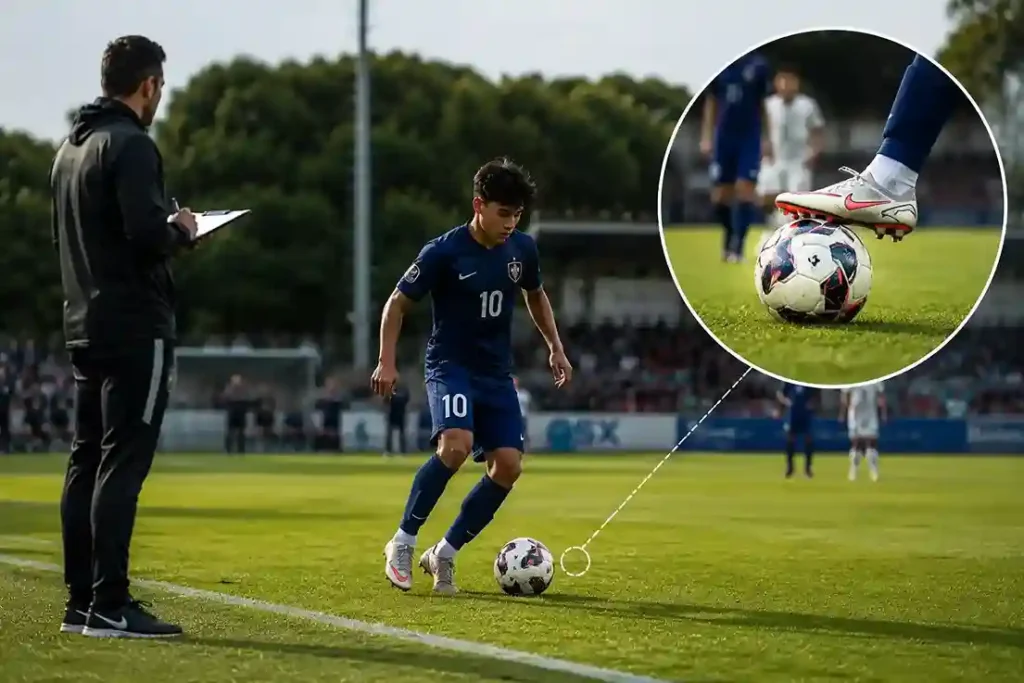
Modern scouting and academy development, in England commonly built around what’s known as the “four corner model,” assesses players across four connected areas, not just footballing skill in isolation:
- Technical — first touch, passing range, finishing, ball control under pressure.
- Physical — speed, strength, stamina, and increasingly, how well a player’s body develops through adolescence.
- Tactical/Psychological — decision-making, game understanding, and the ability to read situations quickly.
- Social/Mental — coachability, resilience after setbacks, and the ability to handle intense competitive pressure from a young age.
The players who make it are rarely the most gifted technically at age 10 — they’re disproportionately the ones who combine strong technical foundations with the mental resilience to survive repeated rejection, injury setbacks, and brutal internal competition for a handful of spots.
Alternative Pathways Beyond the Traditional Academy Route
The traditional academy-to-pro pipeline isn’t the only route, and plenty of professional careers have started differently:
- College/university soccer — particularly common in the United States, where college programs serve as a legitimate scouting pipeline into Major League Soccer and beyond.
- Non-league and lower-division football — many professionals were released by academies as teenagers and rebuilt their path through semi-professional or lower-league football before being scouted again later.
- Late physical development — because puberty timing varies so much, some players who were “too small” or “too slow” at 14 become genuine professional prospects by 17 or 18, once their body catches up.

Education and a Backup Plan Aren’t Optional
Given that even inside elite academy systems the overwhelming majority of players won’t turn professional, most reputable academies now build education and life-skills development directly into a young player’s schedule rather than treating it as an afterthought. This isn’t pessimism — it’s the same realistic planning that any career with such steep odds requires, and it protects players from being left with nothing to fall back on if their playing career doesn’t work out, or ends early due to injury.
Frequently Asked Questions
Based on FIFA’s global player data, roughly 0.04–0.05% of all players who take up the sport reach professional level — about 1 in 2,000 to 2,500. Within elite youth academies specifically, the odds are somewhat better but still steep, with studies suggesting around 1% of academy players ultimately turn professional.
Most professional academies begin formal trials and scouting between ages 8 and 12, though informal scouting and grassroots identification can happen earlier.
Most jurisdictions, aligned with FIFA regulations, allow a first full professional contract from around age 17, following a scholarship or youth contract period typically running from 16 to 18.
No — while most professionals come through academy systems, alternative pathways exist, including college soccer, non-league football, and being scouted at a later age after physical development catches up.
Scouts typically assess four areas: technical ability, physical attributes, tactical/game understanding, and psychological resilience — not just raw skill on the ball.