
Every player who’s ever looked genuinely comfortable on the ball got there the same, unglamorous way: hours of repetition on fundamentals long before anyone was watching. Beginners often skip straight to the flashy stuff — step-overs, long-range strikes — while the players who actually improve fastest spend most of their early training on three or four unglamorous basics, over and over, until they stop having to think about them.
The most effective football training for beginners prioritizes ball mastery (first touch and close control), short passing accuracy, and basic fitness — in that order — before adding tactical concepts or advanced skills. A realistic beginner plan mixes 3–4 sessions a week, each focused on one or two specific skills rather than trying to improve everything at once.
Key Takeaways
- Master the ball before the game — first touch and close control matter more early on than shooting power or tricks.
- Repetition beats variety for beginners — a few drills done correctly hundreds of times build more real skill than dozens of drills done once each.
- Fitness for football is different from general fitness — it’s built around short bursts, direction changes, and recovery, not just running distance.
- The biggest beginner mistake is skipping the boring stuff — most improvement happens in unglamorous repetition, not in trying advanced moves too early.
- Real improvement compounds over a full year, not a single week — a structured 12-month plan, moving from ball mastery through to full match application, builds far more complete skill than repeating the same beginner drills indefinitely.
Suggested Read:
Start With Ball Mastery, Not Tricks
Before anything else, a beginner’s training time should go toward simply feeling comfortable with a ball at their feet. This isn’t about tricks — it’s about basic close control: being able to receive a pass without it bouncing away, changing direction with the ball under control, and using both feet, even if one will always be weaker.
Simple drills that build this fast:
- Toe taps — alternating touches on top of the ball, 2–3 sets of 30 seconds, to build quick foot-ball connection.
- Inside-outside touches — moving the ball with the inside and outside of one foot while walking or jogging forward, then switching feet.
- Wall passes — passing against a wall repeatedly and controlling the rebound with one touch, gradually increasing pace.
Passing: The Skill That Matters Most, Earliest
New players often want to work on shooting first, since it’s the most visible and satisfying skill. But accurate short passing is what actually determines whether a beginner looks comfortable in a real match, because the vast majority of touches in any game are passes, not shots.
What to focus on:
- Accuracy over power — a firm, accurate 10-yard pass to a teammate’s feet is more valuable early on than a powerful pass that’s off-target.
- Both feet — even a small amount of regular practice with the weaker foot pays off enormously once a player starts playing real matches, where there’s rarely time to shift the ball onto a preferred foot.
- Passing under light pressure — once basic accuracy is solid, add a light jog-in defender or simply a countdown timer to simulate the decision-making speed real games require.
⚽ 7-Day Training Plan for Beginners
| Day | Focus | Example Session | Duration |
|---|---|---|---|
| Day 1 | Ball Mastery | Toe taps, inside-outside touches, wall passes | 20–30 min |
| Day 2 | Rest or Light Fitness | Light jogging, stretching, mobility work | 15–20 min |
| Day 3 | Passing Accuracy | Wall passes, partner passing drills, one-touch practice | 30 min |
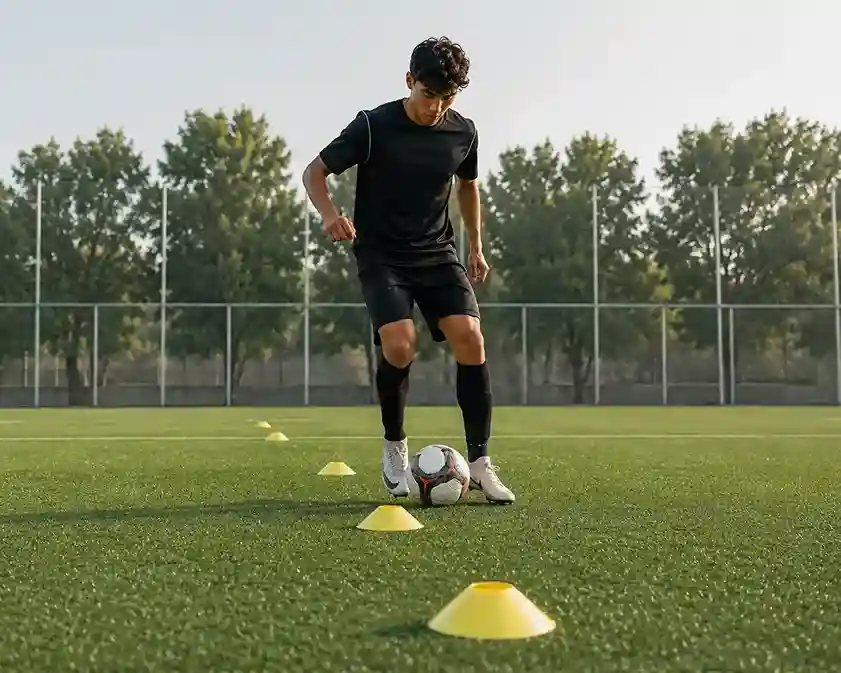
| Day 4 | Dribbling & Change of Direction | Cone dribbling, close control at speed | 30 min |
| Day 5 | Rest | Full recovery, no training | — |
| Day 6 | Small-Sided Game or Shooting Practice | 5-a-side game, or basic shooting technique drills | 45–60 min |
| Day 7 | Rest or Light Activity | Optional light stretching or a walk | 10–15 min |
This is a starting template, not a rigid rule — the important part for beginners is consistency across 3–4 focused sessions a week rather than occasional, unstructured practice.
1-Month Progressive Training Plan for Beginners
A single week of drills builds a habit; a full month is what actually starts building real skill, because each week should slightly raise the difficulty of what you practiced the week before rather than repeating the exact same session four times.
| Week | Main Focus | What Changes From the Week Before |
|---|---|---|
| Week 1 | Foundations — Ball Mastery & Basic Passing | Establish the habit: 3–4 short sessions, walking-pace ball control, and short accurate passes at a standstill. |
| Week 2 | Passing Under Light Movement + Dribbling | Add motion — passing while jogging, cone dribbling at a controlled pace, and introduce light fitness work such as shuttle sprints. |
| Week 3 | Speed & Decision-Making | Increase pace — perform the same drills faster, add a passive defender to passing and dribbling exercises, and begin basic 1v1 practice. |
| Week 4 | Game Application | Combine everything in small-sided games (3v3 or 5v5), applying ball mastery, passing, and movement under real match pressure. |
How to use this plan: Don’t move to the next week’s focus until the current week’s drills feel noticeably easier than when you started — for most beginners training 3–4 times weekly, that’s roughly a week, but there’s no harm in repeating a week if it still feels difficult. The goal by the end of the month isn’t perfection; it’s being able to control, pass, and move with the ball at a real match tempo instead of only at a slow, isolated practice pace.
The Complete 12-Month Football Training Plan
A month builds a foundation; a full year is what actually turns a beginner into a genuinely capable player, because skill, fitness, and game understanding all need to be layered on top of each other in the right order — not all at once. This plan is built around four three-month phases, each with a clear job to do before moving to the next.
| Month | Phase | Primary Focus | Key Skills Added | Fitness Focus | Milestone Check |
|---|---|---|---|---|---|
| 1 | Foundation | Ball mastery at a standstill | Toe taps, close control, both-foot touches | Light mobility, basic conditioning | Can control a rolling pass with one touch, both feet |
| 2 | Foundation | Passing accuracy | Short passing, wall passes, one-touch control | Light shuttle sprints introduced | Consistent accurate 10-yard passes under no pressure |
| 3 | Foundation | Dribbling and movement | Cone dribbling, change of direction, receiving on the move | Basic agility (cone drills) | Comfortable dribbling at a controlled jog, both feet |
| 4 | Development | Passing and control under light pressure | Passing with a passive defender, first-touch under pressure | Increased shuttle sprint volume | Can complete 8/10 passes with a defender jogging in |
| 5 | Development | Shooting technique | Basic shooting form, placement over power | Short sprint intervals | Consistent, accurate shots from close range |
| 6 | Development | Weak-foot development | All prior skills repeated deliberately on the weak foot | Continued agility + light strength basics | Weak foot no longer a clear liability in small drills |
| 7 | Intensification | Speed and 1v1 ability | 1v1 attacking and defending, quick decision-making | Higher-intensity sprint intervals | Can beat a defender 1v1 in a controlled drill |
| 8 | Intensification | Game-speed passing and movement | All passing/dribbling drills done at full match tempo | Match-simulation fitness circuits | Skills hold up at full speed, not just at walking pace |
| 9 | Intensification | Tactical understanding | Positioning, reading the game, basic team shape | Small-sided game conditioning | Understands movement off the ball, not just on it |
| 10 | Mastery | Full match application | Combining all skills in 7v7 / 9v9 games | Match-length conditioning | Performs core skills consistently across a full game |
| 11 | Mastery | Position-specific refinement | Skills tailored to a specific position | Position-specific fitness demands | Understands and executes their specific role clearly |
| 12 | Mastery | Review, consolidation, and goal-setting | Honest self-assessment against Month 1 baseline | Peak conditioning relative to where training started | Can identify strengths and weaknesses accurately |
How the Four Phases Actually Work
- Months 1–3 (Foundation): Everything here happens at a slow, controlled pace on purpose. Speed is added later — first, the basic mechanics of touch, passing, and movement need to become automatic, so they don’t fall apart the moment a game speeds up.
- Months 4–6 (Development): This phase adds pressure and asymmetry — light defenders, shooting technique, and serious weak-foot work. This is usually where a beginner starts to feel like a genuinely different player from where they began, since removing the “always favor the strong foot” habit alone noticeably changes how a player looks on the ball.
- Months 7–9 (Intensification): Everything gets faster and more game-like here. Drills that felt comfortable at a jog in Month 3 now need to hold up at a sprint, under real 1v1 pressure, with actual tactical decisions layered on top.
- Months 10–12 (Mastery): The final quarter is about application, not new technique — taking everything built over the previous nine months and proving it works in real, full-sided games, refined toward whatever specific position suits the player best.
A Realistic Note on Pacing
Not every player will move through these twelve months at exactly this pace, and that’s normal — physical development, prior experience, and how many sessions a week someone can realistically commit to all affect the timeline. Treat the month numbers as a sequence to follow in order, not a strict calendar deadline. A player training only twice a week will reasonably take longer to move through each phase than one training four or five times a week, and that’s a completely fine trade-off for sustainability over burnout.
Building Football-Specific Fitness
General running fitness doesn’t automatically translate to football fitness, because a real match is built around repeated short sprints, sharp direction changes, and quick recovery between bursts of effort — not steady, continuous running.
Beginner-friendly ways to build this:
- Shuttle sprints — short sprints (10–20 meters) with a brief rest, repeated 6–8 times, to mimic real in-game bursts.
- Cone agility drills — quick direction changes around a set of cones, building the sharp turns football actually requires.
- Light continuous running — still useful for basic aerobic fitness and recovery between higher-intensity sessions, just not the main focus.
Common Mistakes Beginners Make
- Practicing advanced skills before basic ones are automatic. A player who can’t reliably control a firm pass has little use for a step-over in a real match.
- Only ever practicing at a standing pace. Real games happen at speed and under pressure — comfort with the ball needs to be tested at match tempo, not just in slow, isolated repetition.
- Neglecting the weaker foot entirely. This creates a predictable, easily defended player, since opponents quickly learn which side to force the ball toward.
- Skipping warm-ups and basic mobility work, which increases injury risk, especially around the hamstrings, ankles, and groin — common trouble spots in a sport built around sprinting and sudden direction changes.
- Training alone, exclusively. Solo drills build technique, but game understanding — reading a pass, sensing pressure, making a decision under time constraints — only develops through actual small-sided games against real opponents.
Building Basic Tactical Understanding
Beginners don’t need complex tactics, but a few simple concepts make a huge difference early on:
- Always look for space, not just the ball — moving into an open area to receive a pass is often more valuable than constantly demanding the ball at your feet.
- Keep your body open — receiving the ball with your body angled toward the direction you want to play, rather than square-on, makes your next touch faster and your options wider.
- Communicate early — calling for a pass or warning a teammate about pressure behind them is a simple habit that dramatically improves how a team plays together, even at a beginner level.
What Equipment Actually Matters
You don’t need much to start: proper football boots suited to the surface you’ll train on (firm ground, artificial turf, or indoor), shin guards for any real match play, and a ball of the correct size for your age group. Cones, a rebound wall or net, and a set of light agility ladders are useful but entirely optional extras — none of them replace consistent repetition of the fundamentals above.
Frequently Asked Questions
3–4 focused sessions per week is a realistic, sustainable starting point, mixing ball mastery, passing, dribbling, and light match-specific fitness, with rest days built in to avoid overuse injuries.
Ball mastery and close control should come before anything else. Being comfortable receiving and controlling the ball under light pressure matters more early on than shooting power or advanced dribbling moves.
Yes. Even limited regular practice with the weaker foot prevents a player from becoming predictable and easily defended once they start playing real matches.
Not on its own. Football requires short sprints, quick direction changes, and rapid recovery between bursts of effort. Shuttle sprints and agility drills are much closer to real match demands.
This varies by individual, consistency, and starting level. However, noticeable improvements in ball control and passing accuracy are often seen within a few months of focused and regular practice.
Yes. A structured 12-month plan works best in four phases: Foundation (ball mastery, passing, dribbling), Development (pressure, shooting, weak foot), Intensification (speed, 1v1s, tactics), and Mastery (full match application and position-specific refinement).