
Moises Henriques’ Portugal Cricket Tests Against Germany’s European Pedigree
Here’s what makes this match genuinely interesting: Portugal cricket arrives at Kerava National Cricket Ground as a team still building combinations around Moises Henriques’ leadership, while Germany cricket walks in as an established associate nation with tournament experience written into their DNA. Germany vs Portugal is scheduled for Saturday, 15 August 2026 at Kerava National Cricket Ground at 16:00 EEST as the 7th Match of Group B in the ICC Men’s T20 World Cup Europe Sub-regional Qualifier C in Finland.
This isn’t just another group-stage match. This is where the real competitiveness of European cricket emerges. Germany cricket ranks 35th in ICC T20 rankings and has played 69 T20 internationals, with their first T20I coming in 2019. That’s genuine depth of experience. Portugal cricket, by contrast, is still proving itself on the international T20 stage despite Henriques’ star power.
Think about the tournament structure for a moment. Group B consists of Czechia, Germany, Greece, Israel and Portugal, with the group winners advancing to the regional final. Only one European spot is available in the 2028 T20 World Cup pathway. That means Portugal can’t afford losses against beatable opposition, and Germany knows this is exactly the kind of fixture they need to navigate successfully if they want to advance.
The Match at a Glance:
- Fixture: Germany vs Portugal (Group B, 7th Match)
- When & Where: August 15, 2026, 4:00 PM EEST | Kerava National Cricket Ground, Finland
- Tournament Context: ICC Men’s T20 World Cup Sub-Regional Qualifier C (2028 World Cup qualification pathway)
- Stakes: Advanced group positioning, World Cup qualification momentum, tournament credibility
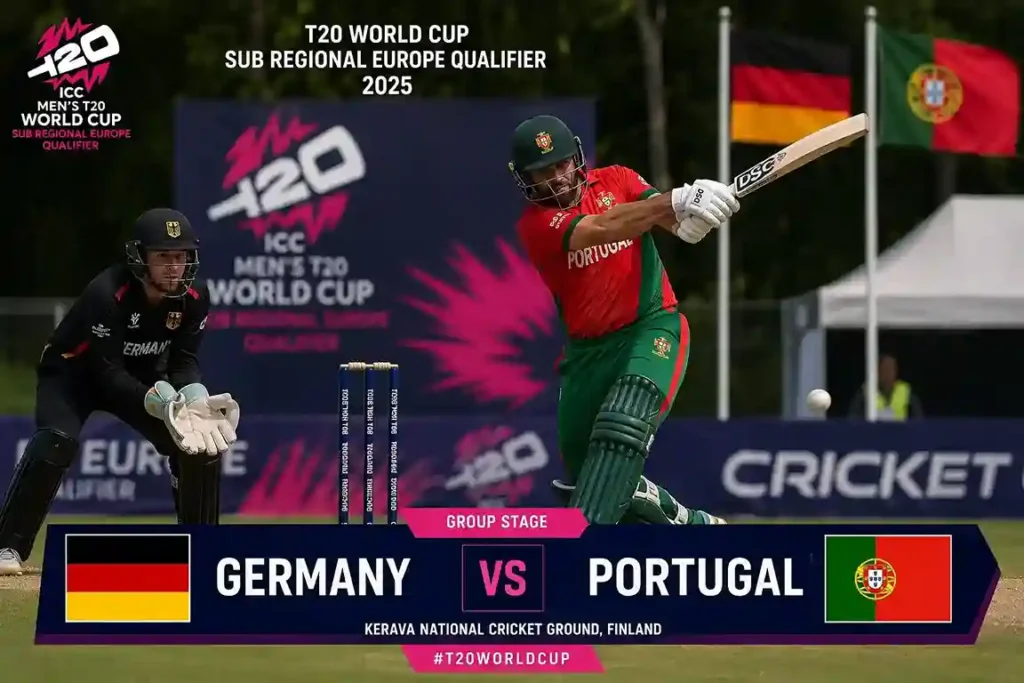
Germany Cricket’s Tournament Pedigree Matters More Than You Might Think
Germany cricket isn’t some emerging associate nation taking their first steps internationally. Germany has competed in T20 World Cup Qualifiers twice, with a best result of 5th place in 2023. That’s tournament experience at the scale where it matters. German cricket has been to the dance multiple times, faced pressure moments, and learned how to win in associate-level competition.
What does that mean in practical terms? It means Germany cricket’s captain, Venkatraman Ganesan, and his coaching staff understand group-stage dynamics. They know the psychology of early matches. They know that Portugal cricket, despite having Moises Henriques as skipper, is still a relatively new combination learning how to function together at the international T20 level.
Look at Germany’s recent form leading into this qualifier. In May 2026, Germany played Austria in a five-match T20 series and won 4-1, showcasing control and consistency against an associate opponent. That’s the kind of form statement you want entering a qualifier. Germany cricket didn’t just win; they won convincingly. They showed the ability to adjust between matches, adapt to opponent strengths, and maintain discipline across a multi-match series.
Venkatraman Ganesan will use that confidence heading into the Portugal fixture. His team has beaten similar-level opposition recently. They know their patterns work. What Germany cricket probably worries about is whether Portugal cricket, elevated by Henriques’ experience and international exposure, can rise above typical associate cricket and execute something unexpected.
Germany cricket’s strength lies in their collective T20 experience and tournament know-how. They’ve been through qualifier pressure before. Germany recently scored 216 and 170 runs in T20 matches against Austria in May 2026, demonstrating batting depth. That’s competitive T20 cricket. When you can put runs on the board consistently, opposition bowlers feel pressure to bowl in difficult areas rather than settling into comfortable rhythm.
The challenge for Germany cricket will be managing Portugal’s unpredictability. Moises Henriques changes the equation entirely. His presence raises Portugal’s ceiling in tight moments and critical overs.
Portugal Cricket’s Henriques Factor Meets Experience Test
Portugal cricket comes to this match having already played Israel cricket in their opening Group B fixture. Depending on that result, this fixture carries completely different pressure. If Portugal won that match, Germany is a chance to consolidate and move toward knockout qualification. If Portugal lost, this becomes nearly do-or-die cricket.
Here’s the reality about Portugal cricket at this stage of their development: they’re fundamentally reliant on Moises Henriques’ individual brilliance combined with smart cricket from teammates. Henriques can anchor an innings, stabilize a shaky situation, or accelerate when the moment demands it. But he’s still just one player, and T20 cricket requires eleven people functioning in sync.
Germany cricket knows this. They’ll gameplan around disrupting Portugal’s batting order early, hoping to catch a Portugal team still gelling without its captain necessarily having to face world-class bowling. If Henriques walks in at position three or four and finds himself fighting his way into a match rather than controlling it, that’s pressure Portugal cricket would rather avoid.
Portugal cricket’s bowling, meanwhile, probably represents their actual vulnerability against Germany. While Portugal cricket has access to all-rounders who bowl, they’re unlikely to have the specialist pace attack that Germany cricket has built over multiple seasons of international cricket. In T20 cricket, bowling depth under pressure is learned through repetition. Henriques’ captaincy helps, but can’t replace experience.
Portugal cricket needs to get their best opening batsmen performing against Germany’s opening bowlers. If Portugal’s opening partnership can build 40-50 runs in the powerplay, then Henriques arrives at a more settled, less complicated batting situation. He can then play his natural game rather than fixing others’ mistakes.
The Tactical Battle: Experience vs. Momentum
Germany’s Tactical Playbook:
Germany cricket will likely approach this match with a clear strategy: bowl tight in the powerplay overs, limit boundaries through accuracy, and capitalize on any early Portugal batting instability. Venkatraman Ganesan’s team has done this repeatedly against Austrian cricket and other associate opposition. They understand that in Group B competition, controlling the first six overs is controlling the match.
Germany cricket’s opening bowlers are probably their strongest asset. If those bowlers can take a wicket in the first two overs—getting Portugal cricket on the backfoot early—the entire match complexion shifts. Portugal cricket would then need Henriques to repair damage rather than build authority.
When batting, Germany cricket will be positive but measured. They’re not reckless. They understand that in a tight group, one poor performance doesn’t eliminate you, but it makes the path harder. A Germany cricket innings that reaches 160-170 is exactly what they want—competitive enough to defend with decent bowling, safe enough that mistakes don’t sink them entirely.
Portugal Cricket’s Strategic Response:
Portugal cricket needs to start aggressively but smart. Their opening batsmen can’t afford to be passive against Germany’s established attack. T20 cricket rewards positive cricket, and Portugal needs to establish momentum early rather than chase it all match.
Moises Henriques will likely come in at three or four depending on how the opening partnership develops. His role is essentially to be the ballast—the player who turns a moderate score into a competitive one, or a dangerous position into recovery. Against Germany cricket’s experienced bowling attack, that stabilizing presence becomes crucial.
Portugal’s bowling needs to be economical and clever. They probably won’t out-pace Germany cricket, but they can out-think them. Unexpected variations, clever field placements, and maybe even some lower-order batting contributions could swing momentum.
Kerava’s Conditions: How Geography Influences This Match
Kerava National Cricket Ground, like other Nordic cricket venues, produces pitches with specific characteristics that favor certain playing styles. August in Finland remains cool—typically 15-18°C—and that weather pattern hasn’t changed from when Israel faces Portugal days earlier.
The Kerava pitch likely offers seam movement to bowlers early in an innings. That’s actually advantage Germany cricket if their opening bowlers execute properly. Seam movement against batsmen new to the crease, in the powerplay when field restrictions apply, creates genuine scoring pressure. Portugal cricket’s opening batsmen will need to be watchful early, which potentially contradicts the aggressive approach they’d like to take.
However, as an innings progresses and batsmen settle in, Kerava’s pitch typically plays easier for batting. That’s when Moises Henriques thrives. An experienced campaigner like Henriques actually prefers coming into an innings when the pitch has been negotiated and is beginning to offer batting opportunities. He’ll find the length quickly and manufacture scoring.
The 4:00 PM start time is also significant. Evening matches in Nordic summers can develop dew as temperatures drop and moisture accumulates on the grass. Dew makes the ball harder to grip for bowlers but easier for batsmen to score freely. If this match reaches the evening (which it likely will), whichever team is batting late has a potential advantage. This makes the toss more consequential than usual—Germany or Portugal winning the toss and choosing to bat or chase becomes a meaningful decision.
Our Match Prediction: Germany’s Experience Edges Portugal’s Potential
Our Assessment: Germany cricket edges this match as slight favorites, likely winning by 12-18 runs if batting first, or by 3-4 wickets if chasing.
Why Germany gets the nod? Start with the fundamentals. Germany cricket has played more T20 internationals than Portugal cricket has even announced squads for. Tournament experience—actual experience from competing in previous qualifiers—gives Germany’s decision-makers a template for managing pressure. Venkatraman Ganesan knows what Group B cricket feels like because he’s experienced it before.
Second, Germany’s recent form against Austria cricket showed they can be disciplined and dominant simultaneously. A 4-1 series win is exactly the kind of statement a team needs to make before a qualifier. Germany cricket is match-sharp, confident, and executing their plans.
Third, and honestly just being direct: Germany cricket’s opening bowlers are probably better than Portugal cricket’s best bowling resources. In a T20 qualifier, securing powerplay advantage often determines match outcomes. If Germany can restrict Portugal to 35-40 runs in six overs, they’ve essentially won the contest already. Portugal cricket would then be chasing the game with Henriques fixing mistakes rather than playing his natural game.
That said—and this is crucial—Moises Henriques genuinely does change things. A single experienced international player can lift a squad’s entire performance level. If Henriques bats with his typical clarity and composure, Portugal cricket could absolutely out-execute Germany’s more predictable approach and win this match. T20 cricket is gloriously unpredictable in that way.
| Team | Match Probability |
|---|---|
| 🇩🇪 Germany Cricket | 55% |
| 🇵🇹 Portugal Cricket | 45% |
It’s competitive. It’s not a blowout prediction. Both teams have legitimate pathways to victory, which is exactly what makes the 7th match of a qualifier genuinely engaging cricket.
FAQ’s: Germany Cricket vs Portugal Cricket
The Bigger Picture: Why Germany vs Portugal Matters for European Cricket
This matchup represents a fascinating intersection in European cricket’s evolution. Germany cricket is established, experienced, and operates with tournament infrastructure. Portugal cricket is emerging, dynamic, and elevated by a world-class captain. When these two energies collide, something interesting happens.
For Germany, a win says they’re still the stable force in European associate cricket. They’re the side that executes and advances. For Portugal, a win with Moises Henriques leading says their new direction is real and competitive. It says Henriques didn’t arrive to manage decline; he arrived to build something.
Both nations are competing for the same World Cup qualification spot. Only one European representative moves through from this sub-regional qualifier. That’s the ultimate pressure. Every match is elimination-adjacent. Every performance is a referendum on a nation’s cricket future. Germany’s tournament experience might trump Portugal’s individual brilliance, but Henriques’ leadership might flip the equation entirely.
Explore More Cricket Analysis & Strategy
Want to understand the tactical dimensions of T20 cricket? Our Cricket Rules Explained guide walks through how matches are actually decided and why certain strategies dominate at different tournament stages.
Curious about how Germany and Portugal will field their players? Read our breakdown of Cricket Fielding Positions to understand why captains like Henriques and Ganesan make specific positioning calls.
New to cricket or qualifier tournaments? Start with What Is Cricket: A Complete Guide to understand the context of why events like this Finland qualifier carry such weight for small nations.
The Verdict: Experience Meets Ambition
Germany cricket and Portugal cricket represent two different stages of associate cricket maturity. Germany is the established side. Portugal is the ambitious upstart. When these teams meet at Kerava, the result will say something important about European cricket’s future.
Germany probably wins this match on balance. Their experience, recent form, and bowling depth are real advantages. But Portugal cricket, captained by a player who’s seen every pressure moment in international cricket, is absolutely capable of disrupting that prediction. That’s the tension that makes T20 cricket beautiful—any team can win on any given day if they execute.
Watch this match if you want to see whether experience truly trumps potential in cricket. Watch it if you’re interested in how individual player brilliance (Henriques) affects team outcomes. And watch it because this is cricket that matters—for nations’ dreams, for qualification pathways, and for European cricket’s competitive evolution. Kerava is hosting something genuinely important.