
Cricket rules go far beyond “how you get out” or “how runs are scored.” The game actually runs on 42 official Laws, maintained by the Marylebone Cricket Club (MCC), and on top of that, the ICC adds its own “Playing Conditions” for each format. This guide skips the basics-only approach and gives you real numbers and official specifications alongside every rule.
Pitch and Field Measurements (Official Dimensions — Law 42)
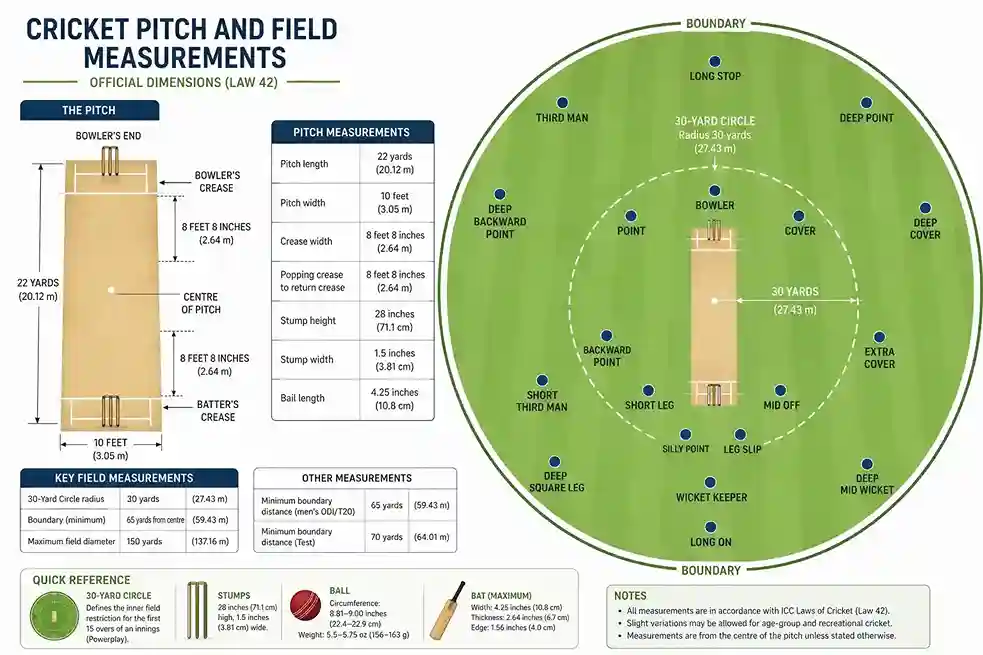
A cricket pitch measures 22 yards long, which is roughly 20.12 meters. The famous “30-yard circle” used during powerplay is actually drawn about 27.43 meters from the middle stump at each end. Here’s the full breakdown of official pitch, crease, and field dimensions as set out in Law 42 of the Laws of Cricket.
Pitch Measurements
| Measurement | Imperial | Metric |
|---|---|---|
| Pitch Length | 22 yards | 20.12 m |
| Pitch Width | 10 feet | 3.05 m |
| Crease Width | 8 ft 8 in | 2.64 m |
| Popping Crease to Return Crease | 8 ft 8 in | 2.64 m |
| Stump Height | 28 inches | 71.1 cm |
| Stump Width | 1.5 inches | 3.81 cm |
| Bail Length | 4.25 inches | 10.8 cm |
Key Field Measurements
| Measurement | Imperial | Metric |
|---|---|---|
| 30-yard Circle Radius | 30 yards | 27.43 m |
| Minimum Boundary | 65 yards | 59.43 m |
| Maximum Field Diameter | 150 yards | 137.16 m |
Minimum Boundary Distance by Format
| Format | Imperial | Metric |
|---|---|---|
| Men’s ODI | 65 yards | 59.43 m |
| Men’s T20I | 65 yards | 59.43 m |
| Test Cricket | 70 yards | 64.01 m |
Powerplay Restrictions
| Format | Powerplay Overs | Maximum Fielders Outside 30-yard Circle |
|---|---|---|
| ODI | First 10 Overs | 2 |
| T20 | First 6 Overs | 2 |
Notes
| Topic | Details |
|---|---|
| 30-yard Circle | Marks the inner-field restriction area used during Powerplays. |
| Measurement Reference | All measurements are taken from the centre of the pitch unless stated otherwise. |
| ICC Standard | Dimensions follow the ICC Laws of Cricket. Minor variations are permitted for junior and recreational cricket. |
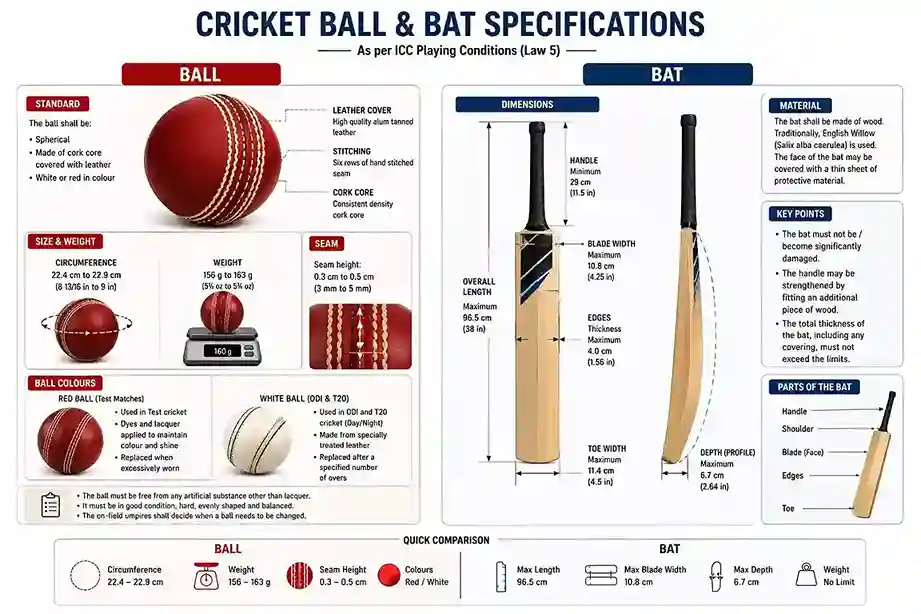
Official Ball and Bat Specifications
Under ICC rules, a new cricket ball must weigh between 155.9 grams and 163 grams, with a circumference between 22.4 and 22.9 centimeters. Bat dimensions are just as strictly regulated — the edges can’t exceed 4.0 centimeters in thickness, and the handle can’t make up more than 52% of the bat’s total length. Only “Type A” bats are allowed in T20 international matches.
Batting and Bowling Basics
Two batters are on the field at any given time — the striker and the non-striker. A batter scores runs by running between the wickets or by hitting a boundary (4 runs) or a six (6 runs). A bowler delivers 6 legal balls per over. If the bowler oversteps the crease or bowls an illegal delivery, it’s called a no-ball, and the batting team also gets a free hit on the next ball.
Fielding Restrictions — With Real Numbers
Some fielding rules apply throughout the match, while others only kick in during powerplay:
- At the instant of delivery, a maximum of 5 fielders are allowed on the leg side
- Only 2 fielders are permitted behind the popping crease on the on side (this applies specifically in ODIs and T20Is)
- No fielder except the bowler can have any part of their body on the pitch until the batter has played the ball
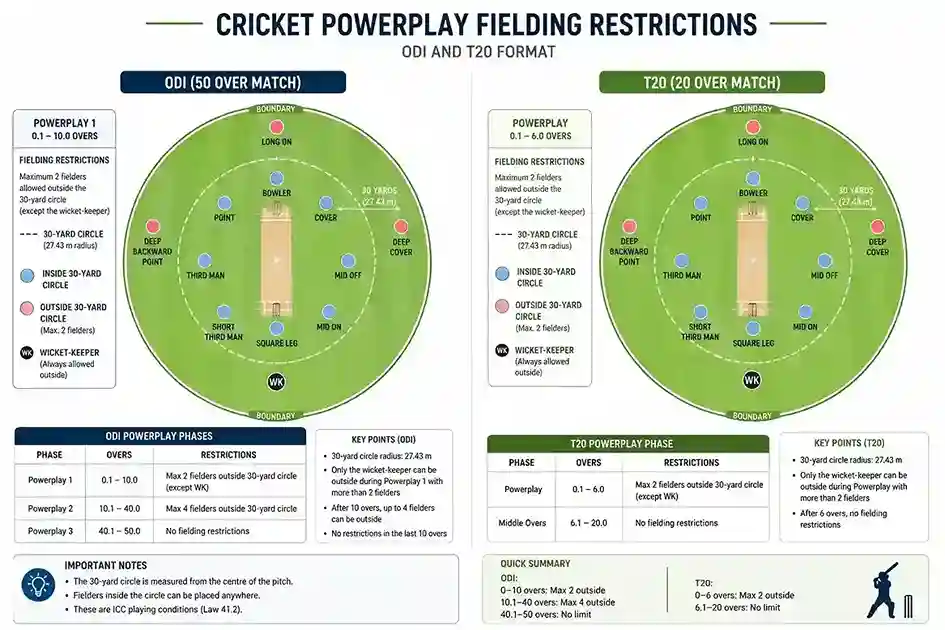
ODI Powerplay — Full Breakdown
An ODI innings is split into three fielding-restriction phases, each with its own fielder cap outside the 30-yard circle:
| Phase | Overs | Fielding Restriction |
|---|---|---|
| Powerplay 1 | 0.1 – 10.0 | Maximum 2 fielders outside the 30-yard circle (excluding the wicketkeeper) |
| Powerplay 2 | 10.1 – 40.0 | Maximum 4 fielders outside the 30-yard circle |
| Powerplay 3 | 40.1 – 50.0 | Maximum 5 fielders outside the 30-yard circle |
- 30-yard circle: The radius is 27.43 m, measured from the centre of the pitch.
- Powerplay 1 fielding restriction: Only the wicketkeeper can be outside the 30-yard circle beyond the 2-fielder limit.
- Inside the circle: Fielders can be placed anywhere inside the 30-yard circle.
- Rain-shortened matches: If the innings is reduced due to rain, all three Powerplay phases are recalculated proportionally according to the ICC’s reduced-overs table.
T20 Powerplay — Full Breakdown
| Phase | Overs | Fielding Restriction |
|---|---|---|
| Powerplay | 0.1 – 6.0 | Maximum 2 fielders outside the 30-yard circle (excluding the wicketkeeper) |
| Non-Powerplay | 6.1 – 20.0 | Maximum 5 fielders outside the 30-yard circle |
- 30-yard circle: The radius is the same as in ODIs — 27.43 m, measured from the centre of the pitch.
- Powerplay fielding restriction: During the first 6 overs, only the wicketkeeper can be outside the 30-yard circle beyond the 2-fielder limit.
- After the Powerplay: From over 6.1 to 20, the restriction eases, allowing a maximum of 5 fielders outside the 30-yard circle.
- Quick summary:
- ODI: Overs 0–10 → max 2 outside · Overs 10.1–40 → max 4 outside · Overs 40.1–50 → max 5 outside
- T20: Overs 0–6 → max 2 outside · Overs 6.1–20 → max 5 outside
If a match is shortened due to rain or other interruptions, the powerplay length is reduced proportionally — for example, a 10-over-per-side match gets just 3 overs of powerplay.
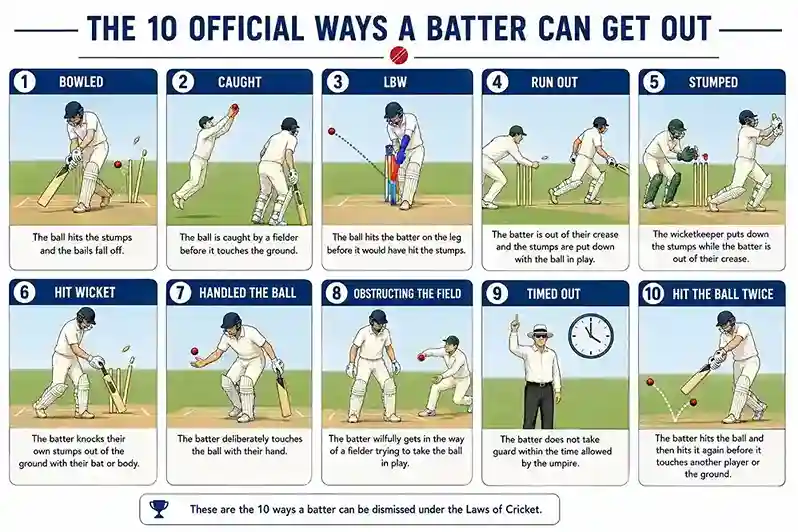
The 10 Official Ways a Batter Can Get Out
According to the Laws of Cricket, there are 10 recognized ways a batter can be dismissed:
- Bowled: The ball hits the stumps directly.
- Caught: The batter’s shot is caught by a fielder before the ball touches the ground.
- LBW (Leg Before Wicket): The ball hits the batter’s pad in line with the stumps and would have gone on to hit them.
- Run Out: The stumps are broken while the batters are attempting a run and the batter is out of their crease.
- Stumped: The batter is out of their crease and the wicketkeeper removes the bails without a run being attempted.
- Hit Wicket: The batter dislodges the stumps with their own bat or body while playing the ball or setting off for a run.
- Handled the Ball: Now incorporated into Obstructing the Field under the Laws of Cricket.
- Obstructing the Field: The batter deliberately interferes with the fielding side.
- Timed Out: The incoming batter fails to reach the crease within the allotted time.
- Hit the Ball Twice: The batter deliberately strikes the ball a second time, except to protect the wicket.
Extras and the Penalty Run System
Because of errors by the bowling side, the batting team can be awarded several types of extra runs — wides, no-balls, byes, and leg-byes. On top of that, serious violations (such as ball tampering or deliberate time-wasting) result directly in 5 penalty runs.
The Stop-Clock Rule (In Effect Since 2024)
Since June 2024, a new rule applies to men’s ODIs and T20Is — the bowling team must start the next over within 60 seconds of the previous one ending. The umpire issues two warnings first, and after that, every further breach costs the batting team’s opponents 5 penalty runs. The rule was introduced to cut down on slow over-rates.
How the DRS System Works
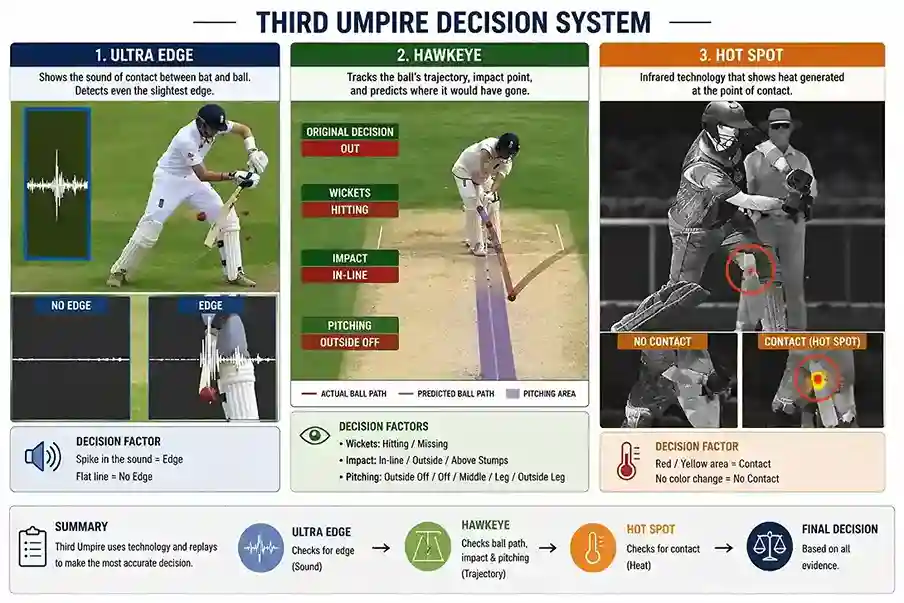
The Decision Review System (DRS) relies on three main technologies, used together in sequence by the third umpire to reach a final decision.
-
UltraEdge (Snickometer)
UltraEdge displays the sound of contact between the bat and ball as a visual sound wave, detecting even the faintest edge. It is the modern, more sensitive successor to the older Snickometer.
Decision factor: A spike in the sound wave indicates an edge, while a flat line indicates no edge.
-
Hawk-Eye
Hawk-Eye tracks the ball’s full trajectory, identifies the impact point on the pad, and predicts where the ball would have gone if it had not been interrupted. It is primarily used for LBW decisions.
Decision factors:
- Wickets: Was the ball hitting the stumps or missing them?
- Impact: Was the impact in line with the stumps, or outside/above them?
- Pitching: Did the ball pitch outside off, on off/middle/leg, or outside leg?
-
Hot Spot
Hot Spot uses infrared imaging to reveal the heat generated at the point of contact between the ball and the bat or pad.
Decision factor: A red or yellow mark indicates contact, while no color change indicates no contact.
How the Third Umpire Puts It Together
The review process typically runs in this order: UltraEdge checks for an edge (sound) → Hawk-Eye checks the ball’s path, impact, and pitching (trajectory) → Hot Spot checks for contact (heat) → the third umpire combines all three pieces of evidence to make the final decision.
Each team gets a limited number of reviews per innings, and every review is sent to the third umpire for this multi-step check before the on-field decision is confirmed or overturned.
Overs by Format
- Test Cricket — no over limit, played across 5 days
- ODI — each team gets 50 overs
- T20 — each team gets 20 overs
For a full breakdown of how these formats differ, check out our What Is Cricket — A Beginner’s Guide article.
Conclusion
Cricket’s rules aren’t just textbook trivia — behind them lies precise measurement, real data, and decades of refinement, all designed to keep every match fair and exciting. From the exact length of the pitch to the fielder count during powerplay, every rule serves a logical purpose. Next time you watch a match, this data will help you understand the game on a much deeper level.