
Football looks simple from the outside — kick the ball into the net more times than the other team — but the rules that shape every match can trip up even casual viewers. Why did the referee blow the whistle when nobody touched anyone? What’s actually being reviewed on VAR for three minutes? This guide breaks down everything a new fan needs to follow a match without needing a friend to explain it every five minutes.
The Basic Objective
Two teams of 11 players try to score more goals than their opponent within the match’s time limit by getting the ball fully across the opposing goal line, between the posts and under the crossbar. Whoever scores more goals wins. If the scores are level at full time, the result depends on the competition — league matches usually end in a draw, while knockout matches move to extra time and then a penalty shootout if needed.
The Field and Equipment
A standard football pitch is rectangular, typically between 100–110 meters long and 64–75 meters wide for professional matches. Each end has a goal 7.32 meters wide and 2.44 meters high. The penalty area is the large box in front of each goal — anything that happens inside it carries extra weight, especially fouls, which can result in a penalty kick.
| Pitch Feature | Standard Measurement |
|---|---|
| Pitch Length | 100–110 meters |
| Pitch Width | 64–75 meters |
| Goal Width | 7.32 meters |
| Goal Height | 2.44 meters |
| Penalty Area | 40.3 m wide × 16.5 m deep |
| Goal Area (Six-yard Box) | 18.32 m wide × 5.5 m deep |
| Center Circle Radius | 9.15 meters |
| Penalty Spot Distance | 11 meters from goal line |
| Corner Arc Radius | 1 meter |
The ball itself is also standardized under IFAB (International Football Association Board) Laws of the Game:
| Ball Specification | Official Standard |
|---|---|
| Circumference | 68–70 cm |
| Weight (at Kickoff) | 410–450 grams |
| Pressure | 0.6–1.1 atmospheres at sea level |
| Material | Leather or approved synthetic |
Player Equipment (Law 4)
Every player must wear a set of compulsory basic equipment, and referees check this before kickoff. The two teams — plus the goalkeepers — must also wear kits that clearly contrast with each other so players can be told apart at a glance.
| Compulsory Item | Purpose / Rule |
|---|---|
| Jersey/Shirt | Team identification; goalkeepers wear a distinct color from both teams and the officials. |
| Shorts | Must match or coordinate with the team kit (undershorts/base layers allowed if the same color as the shorts). |
| Socks | Worn pulled up over the shin guards. |
| Shin Guards | Compulsory for all outfield players; must be covered entirely by the socks. |
| Footwear | Studded or molded boots suitable for the playing surface. |
Jewelry, watches, and any equipment judged dangerous to the player or others (hard casts, sharp objects, etc.) are banned under the same law. Goalkeepers are additionally permitted to wear padded gloves and caps, which aren’t required for outfield players.
Every rule in this guide comes from the sport’s official rulebook, known as the Laws of the Game, maintained by the International Football Association Board (IFAB) — the same body FIFA defers to for any rule change worldwide. The rulebook is organized into 17 core laws, covering everything from the pitch and ball to fouls, offside, and VAR.
The Players and Positions
Each team fields 11 players, one of whom is the goalkeeper — the only player allowed to use their hands, and only within their own penalty area. The other 10 outfield players are generally grouped into three roles:
- Defenders — positioned closest to their own goal, focused on stopping opposition attacks
- Midfielders — operate in the center of the pitch, linking defense and attack
- Forwards/Strikers — positioned closest to the opponent’s goal, primarily responsible for scoring
Teams arrange these positions into formations, like a 4-4-2 (four defenders, four midfielders, two forwards) or a 4-3-3, depending on tactical approach.
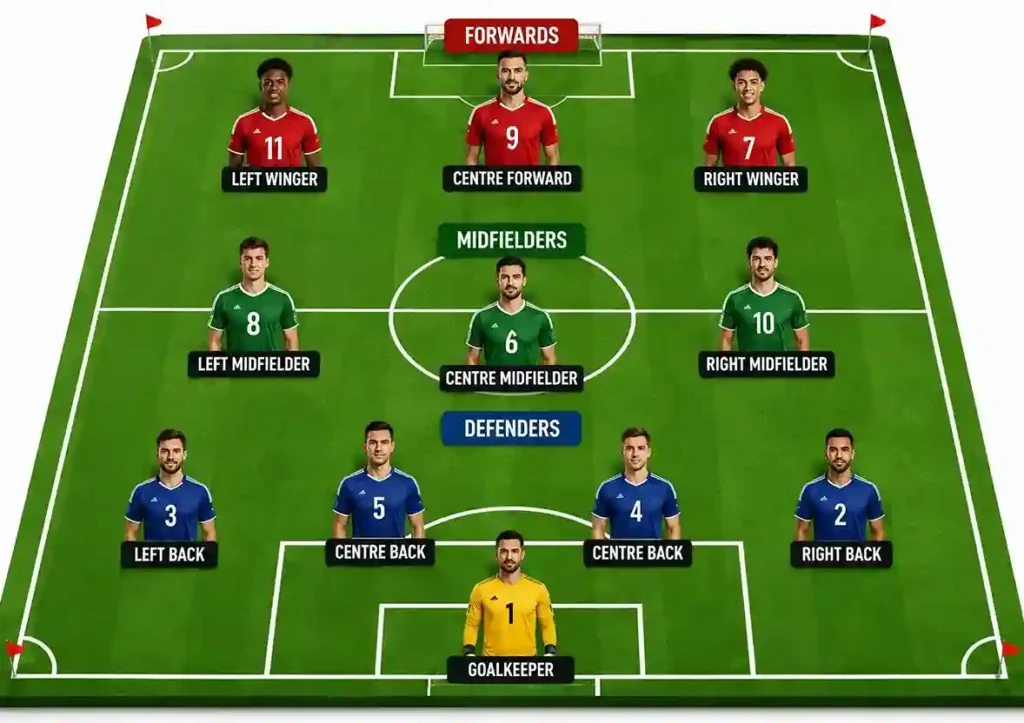
Football Player Positions, Roles & Key Skills
| Position | Role | Key Skills |
|---|---|---|
| Goalkeeper (GK) | Protects the goal, prevents opponents from scoring, uses hands inside the penalty area. | Reflexes, Handling, Positioning |
| Right Back (RB) | Defends the right side, supports the attack, delivers crosses. | Tackling, Stamina, Crossing |
| Left Back (LB) | Defends the left side, supports attacking moves, provides width. | Tackling, Stamina, Crossing |
| Centre Back (CB) | Stops opponents from scoring, protects the goal, clears the ball from danger. | Marking, Tackling, Heading, Strength |
| Centre Midfielder (CM) | Controls the game, links defense and attack, distributes the ball. | Passing, Vision, Positioning |
| Left Midfielder (LM) | Supports both attack and defense, creates chances from the left side. | Passing, Stamina, Work Rate |
| Right Midfielder (RM) | Creates scoring opportunities, supports attack and defense. | Passing, Dribbling, Creativity |
| Right Winger (RW) | Attacks from the right wing, creates chances with pace and crosses. | Dribbling, Speed, Crossing |
| Centre Forward (CF) | Scores goals, leads the attack, finishes scoring opportunities. | Finishing, Positioning, Strength |
| Left Winger (LW) | Attacks from the left wing, beats defenders and creates chances. | Dribbling, Speed, Crossing |
Match Duration and Structure
A standard match lasts 90 minutes, split into two 45-minute halves with a short break in between. The referee adds “stoppage time” (also called injury time) at the end of each half to make up for time lost to injuries, substitutions, or delays. In knockout competitions, a match tied after 90 minutes moves to two 15-minute periods of extra time, and if still level, a penalty shootout decides the winner.
Four officials typically run a professional match: the main referee, two assistant referees on the touchlines (who help spot offside and out-of-play balls), and a fourth official on the sideline managing substitutions and added time. In competitions using VAR, an additional off-field team reviews footage from a separate video room.
How Scoring Works
A goal is scored when the entire ball crosses the goal line between the posts and under the crossbar, provided no rule violation (like offside or a foul) occurred in the buildup. Every goal counts as one point regardless of how it was scored — there’s no equivalent of a two- or three-point shot like in basketball.
The Offside Rule, Explained Simply
This is the rule that confuses new fans the most. A player is offside if, at the moment the ball is played to them by a teammate, they are nearer to the opponent’s goal line than both the ball and the second-to-last opponent (usually the last outfield defender), and they’re in the opposition’s half of the pitch.
In plain terms: an attacking player can’t be standing beyond the last defender, waiting for a pass, when the ball is played forward to them. The rule exists to prevent players from simply camping next to the goal and “goal-hanging.” Offside is only judged at the exact moment the ball is passed — not when the player receives it — which is why tight offside calls are now often reviewed by VAR using frozen frame lines.
Fouls and Free Kicks
A foul occurs when a player commits an offense like tripping, pushing, holding, or handling the ball deliberately. Fouls are punished with a free kick for the opposing team, taken from where the offense happened. There are two types:
- Direct free kick — the ball can be kicked straight into the goal to score
- Indirect free kick — the ball must touch another player before a goal can count, usually awarded for more technical offenses like offside or dangerous play without contact
Penalty Kicks
If a foul that would normally result in a direct free kick happens inside the offending team’s own penalty area, the referee awards a penalty kick instead. The ball is placed on the penalty spot, 11 meters from goal, and the attacking player takes a shot with only the goalkeeper standing in the way. Across professional football, penalties in regular play are converted roughly 75–80% of the time, which is why conceding one is treated as a serious error — and why the small group of players who miss consistently stand out so much.
Yellow and Red Cards
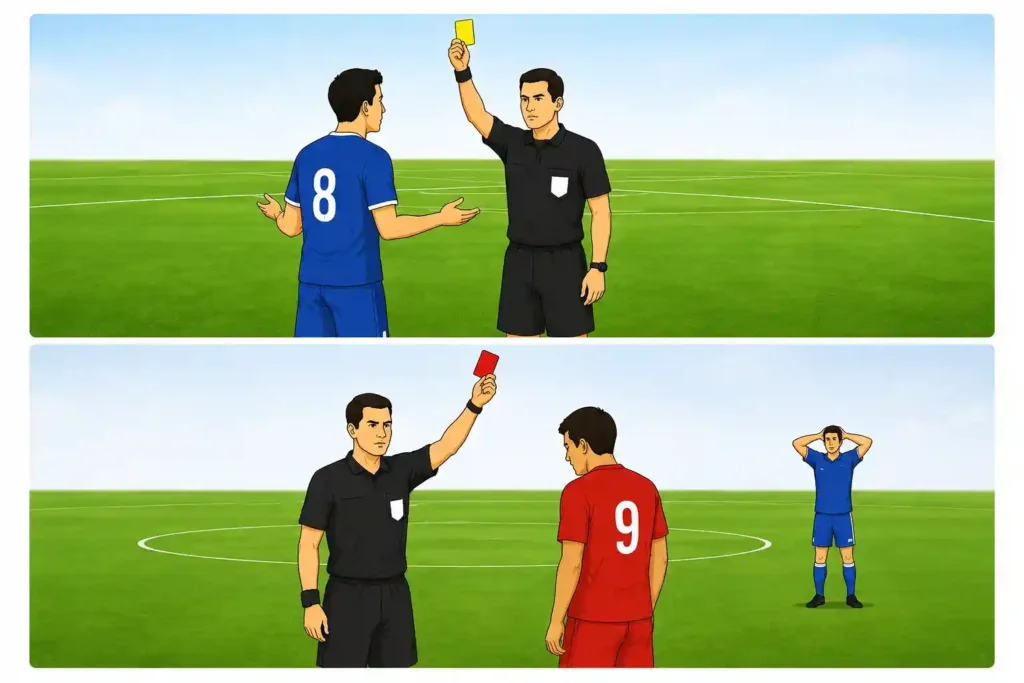
Referees use cards to manage discipline:
Referee Cards
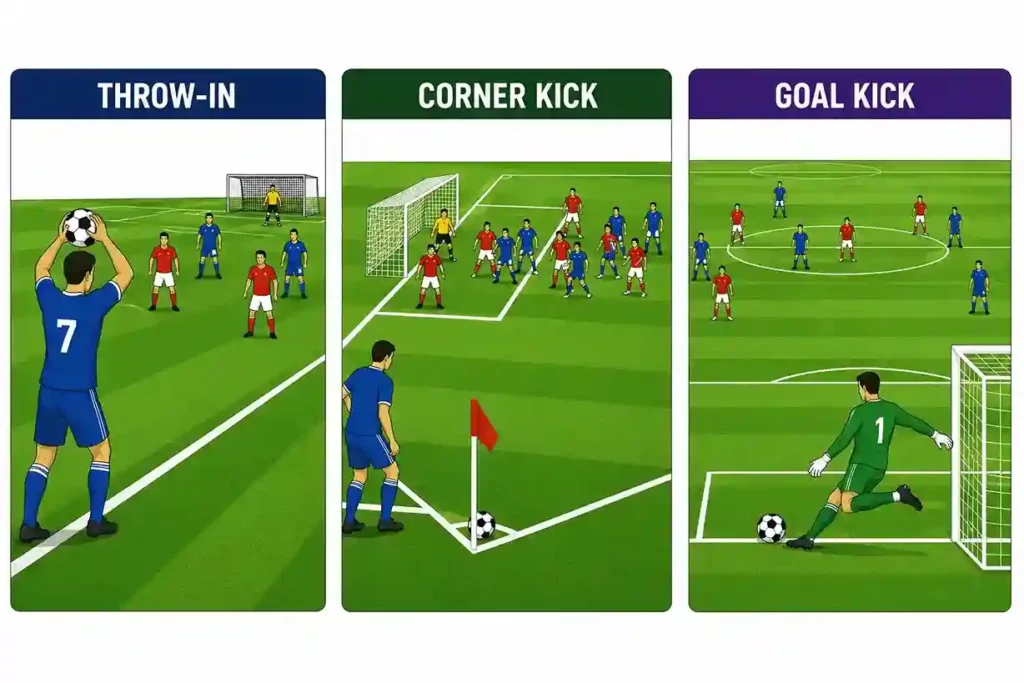
Throw-ins, Corners, and Goal Kicks
What Is VAR?
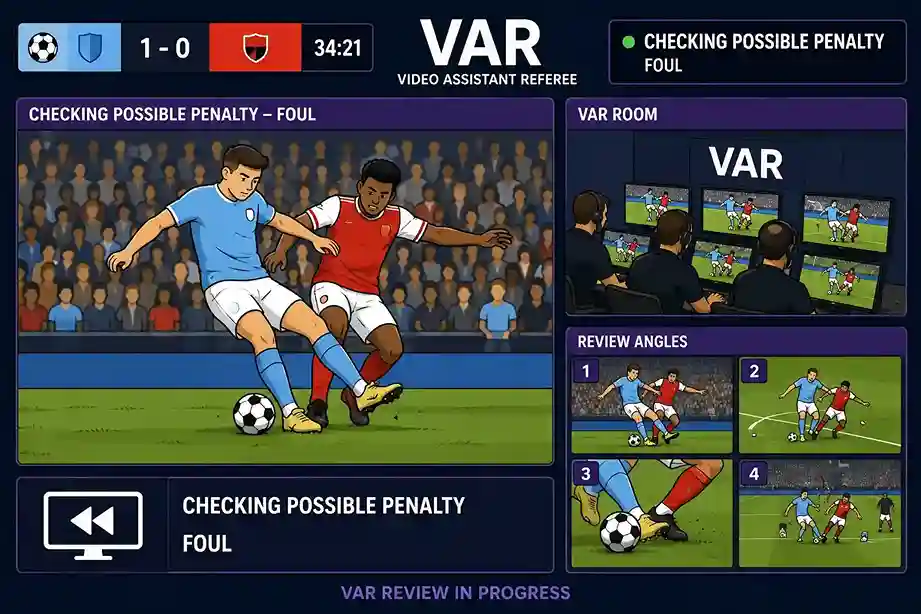
VAR (Video Assistant Referee) is a system where off-field officials review key match incidents using video replays. VAR typically gets involved in four situations: goals, penalty decisions, direct red cards, and cases of mistaken identity. If the on-field referee’s decision looks clearly wrong on review, VAR can recommend they check the pitch-side monitor themselves before making a final call. It’s designed to correct clear and obvious errors, not to re-referee every marginal call.
Despite its reputation for dragging matches to a halt, the Premier League’s own data put the average delay caused by a VAR check at around 50 seconds per incident. Offside decisions are now among the fastest calls thanks to semi-automated offside technology, which uses tracking data and a sensor in the ball to flag close calls in roughly 20–30 seconds — down from the much longer manual line-drawing process VAR first launched with.
Frequently Asked Questions
What is the easiest way to understand offside?
Think of it as needing to stay level with or behind the last defender until the ball is actually played forward. If you’re ahead of that defender when your teammate passes, you’re offside.
How long is a football match?
A standard match is 90 minutes, made up of two 45-minute halves, plus stoppage time added by the referee at the end of each half.
What happens if a match is tied after 90 minutes?
In league play, the match simply ends in a draw. In knockout competitions like the World Cup, it moves to 30 minutes of extra time, followed by a penalty shootout if the scores remain level.
Can a goalkeeper score a goal?
Yes. A goalkeeper can score from open play, free kicks, or even a well-timed run forward during a late-game corner, though it’s rare since they’re needed in goal.
Why do fouls sometimes not result in a free kick?
Referees use judgment to allow the “advantage” rule. If the fouled team is in a better attacking position by playing on rather than stopping for a free kick, the referee can wave play forward instead of stopping it.
Football Rules in Numbers
For readers who just want the key data points in one place:
Key Data Points
| Data Point | Figure |
|---|---|
| Total official Laws of the Game | 17 (set by IFAB) |
| Players per team | 11 (including 1 goalkeeper) |
| Match duration | 90 minutes (2 × 45-minute halves) |
| Extra time (knockouts only) | 30 minutes (2 × 15-minute halves) |
| On-field match officials | 4 (Referee, 2 Assistant Referees, 4th Official) |
| Penalty spot distance | 11 meters from the goal line |
| Average penalty conversion rate | ~75–80% |
| Average VAR review delay | ~50 seconds per incident |
| Semi-automated offside check time | ~20–30 seconds |
| Yellow cards to trigger a red | 2 in the same match |
Quick Recap Table
| Term | What It Means |
|---|---|
| Offside | Attacker ahead of the last defender when the ball is played to them. |
| Direct free kick | Can be shot straight into the goal. |
| Indirect free kick | Must touch another player before a goal counts. |
| Penalty kick | Direct free kick offense committed inside the penalty area. |
| Yellow card | Caution; two yellow cards in the same match result in a red card. |
| Red card | Immediate sending-off; the team continues with one fewer player. |
| VAR | Video review for goals, penalties, red cards, and mistaken identity. |
Final Whistle
Once you’ve got offside, fouls, cards, and the basic flow of a match down, everything else about football starts falling into place naturally. The rules are built to keep the game fair and fast-moving—and once you can spot them yourself, watching a match becomes a whole lot more fun.
Got a football rule that still confuses you? Drop it in the comments and we’ll break it down in a future post.