
There is no piece of technology in modern football that produces more collective breath-holding than a referee jogging toward the touchline monitor. Fifty thousand people in a stadium, and millions more watching at home, all pause at once — some certain they’ve been wronged, others certain justice is finally coming. That reaction, repeated in nearly every match at the highest level of the sport, is VAR.
VAR (Video Assistant Referee) is a video review system used in football to correct clear and obvious errors in four situations only — goals, penalty decisions, direct red cards, and mistaken identity. A team of officials reviews match footage from a separate room and advises the on-field referee, who always makes the final decision.
Key Takeaways
- VAR only reviews four categories: goals, penalties, direct red cards, and mistaken identity — nothing else.
- The referee, not the video team, always makes the final call.
- Objective/factual decisions (like offside) get corrected automatically; subjective decisions (like a foul) need a personal on-field review by the referee.
- There is no player or coach challenge system in football — only match officials can trigger a VAR review.
- 2026 brought corner kick reviews, certain second-yellow-card reviews, referee body cameras, and faster offside alerts.
This guide covers everything: what VAR is, exactly how it works step by step, what it can and can’t review, how the process looks in real time, what’s changed heading into 2026, and the genuine controversies that still surround it.
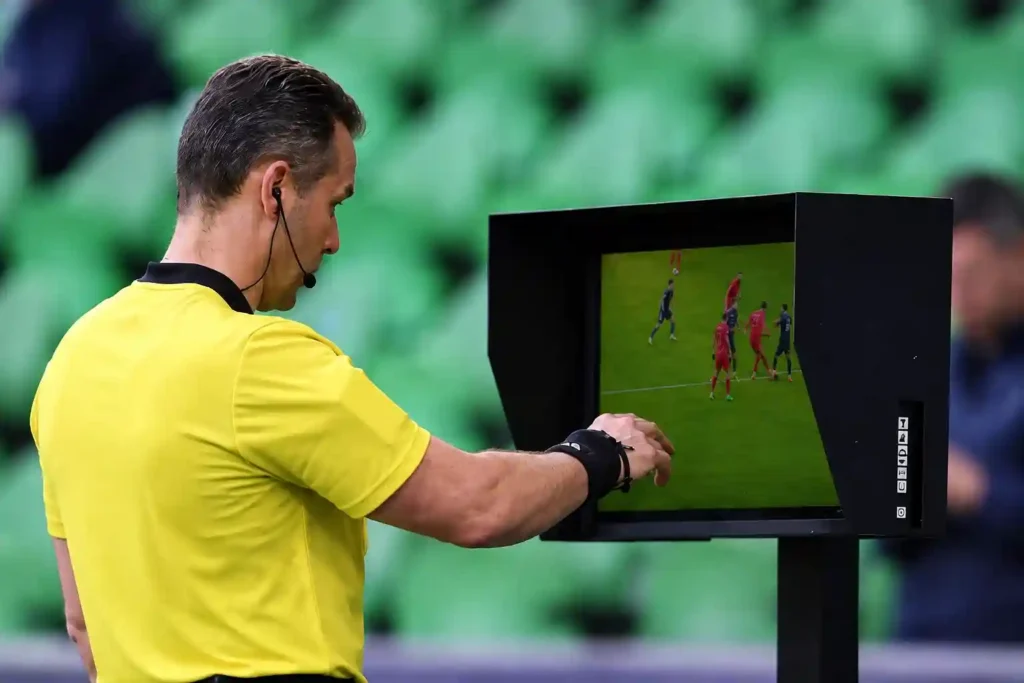
What Is VAR in Football and Why Was It Introduced?
VAR stands for Video Assistant Referee. It refers both to the technology system and to the actual match official who uses it. The football VAR system was introduced for one specific purpose: catching a clear and obvious error in a small number of match-changing situations that the referee didn’t see, or couldn’t see properly, in real time. It is not a second referee running the match from a screen. It does not make decisions. It advises. The referee on the pitch always makes the final call.
That distinction matters enormously, because most confusion about VAR comes from people assuming it’s meant to review everything. Ask yourself this: if VAR checked every throw-in, every tactical foul, every marginal shirt-pull, would football even be watchable anymore? It isn’t designed to. It exists to fix major, game-changing mistakes — not to relitigate every marginal 50-50 decision in a match.
The History of VAR: How We Got Here
- 2016 — VAR was trialled for the first time in official matches, starting with lower-profile competitions and friendly matches used as testing ground by IFAB (the International Football Association Board, which writes football’s Laws of the Game).
- 2017 — The system got its first real spotlight at the FIFA Confederations Cup, a dress rehearsal tournament before the following year’s World Cup.
- 2018 — VAR made its official World Cup debut in Russia, becoming a permanent fixture of the sport’s biggest stage from that point onward.
- 2018–2022 — Domestic leagues around the world adopted VAR at different speeds, with the Premier League, Serie A, La Liga, and Bundesliga all implementing it between 2019 and 2020.
- 2022 — Semi-automated offside technology (SAOT) was introduced at the Qatar World Cup, working alongside VAR specifically for offside calls.
- 2026 — The most significant rule expansion since VAR’s introduction: new reviewable categories, an upgraded offside system, referee body cameras, and in-stadium announcements of VAR decisions.
How VAR Works in Football: Step by Step
1. The Video Operation Room (VOR)
During every match at the highest level, a team of officials sits in a centralized Video Operation Room, watching the game live across dozens of camera angles — at the 2026 World Cup, up to 33 separate camera feeds per stadium. This team is not in the stadium itself; they work from a broadcast production facility, watching the same match through professional broadcast equipment.
2. The Silent Check
Here’s the part most fans don’t realize: VAR is checking every single phase of play, on every single match, constantly — silently, invisibly, without ever stopping the game. This happens automatically in the background for the vast majority of passages of play. You never see or hear about it, because nothing gets flagged.
3. The Flag: When VAR Speaks Up
If the VAR team spots what looks like a clear and obvious error in one of the four reviewable categories (explained below), they communicate directly with the on-field referee through a private radio headset channel. This conversation is not broadcast to the stadium or the crowd — it’s a private line between the referee and the video team.
4. The Referee’s Decision Point
At this stage, the referee has two options:
- Accept VAR’s information directly — for purely factual, objective situations (a ball crossing the touchline for a throw-in, whether a player was offside, whether the ball hit a hand before going out for a corner), the referee can simply take the VAR team’s word for it and change the decision without a personal video review.
- Go to the pitchside monitor — for anything with a subjective element (was that tackle a red card offense? Was that a penalty?), the referee will jog to the sideline and personally review the footage on a monitor before making the final call themselves.
5. The TV Signal
When a referee is about to conduct an on-field review or officially change a decision, they make a distinctive gesture — drawing a rectangle in the air with both hands, mimicking an old-fashioned TV screen. This is the universal signal that VAR is now formally involved in the decision, and it’s the moment the crowd usually erupts into anticipation.
6. The Final Call
Whether the referee accepts VAR’s factual input directly or reviews the footage personally, the final decision always belongs to the referee on the pitch — not the video team. This is a deliberate design choice: VAR advises, the referee decides.
The Four Reviewable Categories (And Nothing Else)
This is the single most important thing to understand about VAR: it can only intervene in four specific categories. Everything else on the pitch — every foul, every throw-in, every tactical foul, every dive — is entirely left to the on-field officials, exactly as it always was before VAR existed.
- Goals — Was there an offside, a foul, or a handball in the buildup that should have prevented the goal from counting?
- Penalty decisions — Should a penalty have been given, or should a penalty that was given actually not have been?
- Direct red cards — Was a sending-off correctly or incorrectly given for a serious foul, violent conduct, or denial of an obvious goal-scoring opportunity?
- Mistaken identity — Did the referee book or send off the wrong player entirely, confusing them with a teammate?
Every VAR intervention in football, anywhere in the world, falls into one of these four buckets. Here’s the same information as a quick-reference table:
| Situation | Can VAR Review It? |
|---|---|
| Goals (offside, foul, or handball in the buildup) | Yes |
| Penalty decisions (given or not given) | Yes |
| Direct red cards | Yes |
| Mistaken identity (wrong player booked/sent off) | Yes |
| Throw-ins | No |
| Regular fouls/free kicks outside the box | No |
| Corner kicks (pre-2026) | No — added as reviewable starting 2026 |
| Yellow cards (first bookings) | No |
Who Actually Writes These Rules? A Quick Word on IFAB
You’ll see “IFAB” mentioned throughout this guide, and it’s worth knowing what it actually is. The International Football Association Board is the body that writes and amends the Laws of the Game — the official rulebook every competition in the world, from the World Cup down to your local Sunday league, is technically bound by. It’s a small, unusual organization: FIFA holds half the voting power, while the football associations of England, Scotland, Wales, and Northern Ireland hold the other half between them, a legacy of those four nations effectively inventing the modern rules of football in the 19th century. Any major change to VAR — including everything new for 2026 — has to be formally approved by IFAB first.
VAR vs Goal Line Technology — Not the Same System
It’s easy to lump every piece of football technology together, but VAR and goal line technology solve two completely different problems. Goal-line technology uses a network of high-speed cameras or a microchip inside the ball to answer one single, purely factual question: did the ball fully cross the goal line? It sends an instant vibration and visual alert to the referee’s watch within about a second — no review, no delay, no human judgment involved at all. VAR, by contrast, covers a much broader range of decisions (goals, penalties, red cards, mistaken identity) and frequently does involve human judgment, which is exactly why it takes longer and generates far more controversy. Goal-line technology has existed since 2012 and is rarely discussed simply because it works instantly and objectively; VAR gets all the attention because it doesn’t.
“Clear and Obvious” vs Objective Fact — The Distinction That Confuses Everyone
There are actually two very different standards VAR applies, depending on the type of decision:
- Objective/factual decisions: Was the ball offside? Did it cross the goal line? Did it touch a hand before going out for a corner? For these, there’s no “clear and obvious” threshold at all — even an offside call decided by a matter of millimeters gets corrected, because it’s a simple fact, not a judgment call.
- Subjective decisions: How serious was that tackle? Was that shirt-pull inside the box enough for a penalty? For these, VAR only intervenes if the on-field referee’s original decision was a clear and obvious error — meaning most neutral observers would agree it was clearly wrong, not just debatable. A borderline, 50-50 call stays exactly as the referee originally called it, even if some fans disagree.
This dual standard is precisely why VAR corrects millimeter-perfect offside calls instantly, but still allows plenty of contentious penalty and red-card decisions to stand — and it’s the single biggest source of ongoing fan frustration with the system.
What’s New for VAR at the 2026 World Cup
IFAB approved a significant expansion of VAR’s powers for 2026, alongside several supporting technology changes:
- Corner kick reviews — VAR can now correct an incorrectly awarded corner kick versus goal kick (or vice versa), a situation that previously had no review mechanism at all despite directly leading to goals in some cases.
- Second yellow card reviews — If a player is shown a second yellow card (resulting in a red) for an offense that, on review, clearly wasn’t a bookable offense at all, VAR can now step in to overturn it.
- Expanded mistaken identity reviews — The criteria for correcting a mistaken-identity card have been broadened to cover clearer cases than before.
- Referee body cameras — Officially permitted in the Laws of the Game after being trialled at the 2025 Club World Cup under the name “Referee View.” Footage from the referee’s own body camera now feeds directly into broadcasts and stadium screens, giving fans the official’s exact eyeline during key incidents.
- In-stadium VAR announcements — For select major decisions, the referee can now explain the outcome of a VAR review directly to the crowd over the stadium’s public address system, using a dedicated broadcast channel separate from the officials’ private communication line. This builds on a transparency measure first trialled at the 2023 FIFA Women’s World Cup.
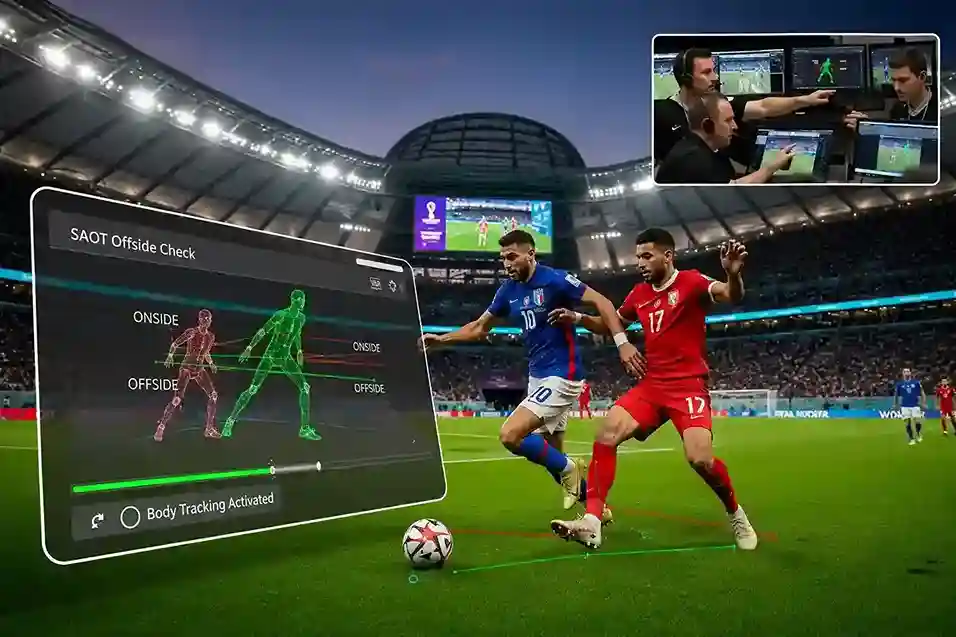
- Faster offside decisions via SAOT — The semi-automated offside system, first introduced in 2022, has been upgraded for 2026 with instant audio alerts sent directly to the assistant referee the moment a clearly offside position is detected, cutting review times from three to four minutes down to under sixty seconds in most cases. The system builds a 3D avatar of every one of the 1,248 players at the tournament and tracks limb and ball position dozens of times per second, with the detection threshold tightened to roughly 10 centimeters.
VAR vs Semi-Automated Offside Technology (SAOT) — Are They the Same Thing?
No, and this is a common point of confusion. VAR is the overall video review system covering all four reviewable categories. SAOT is a specific technology that works underneath VAR, purpose-built only for offside calls, using camera tracking and 3D player modeling rather than a human video official manually drawing lines across a frozen frame. Think of SAOT as one specialized tool inside VAR’s broader toolkit — VAR still handles goals, penalties, red cards, and mistaken identity manually, while SAOT specifically accelerates and sharpens the offside piece of that puzzle.
Rules Fans Often Get Wrong About VAR
Even fans who watch every week tend to misunderstand a handful of specific VAR rules. Here’s what actually holds up under the Laws of the Game — and what’s just stadium myth:
- No coach or player challenges exist in football. Unlike tennis or American football, there is no formal mechanism for a team to request a VAR review. Only the VAR team and the referee can initiate one. Protesting for a review can actually earn a player a yellow card.
- The private headset channel is never broadcast publicly — only the newer, separately activated stadium announcement channel is, and only for select major decisions the referee chooses to explain.
- VAR does not review every foul or subjective call — it is strictly limited to the four categories above, no matter how significant a missed foul elsewhere in midfield might feel to fans watching.
- A “mouth covering” gesture during an argument with an opponent is now a straight red card under 2026 rules, introduced specifically to prevent players from hiding abusive or discriminatory language directed at an opponent from lip-readers and broadcast microphones.
Real Example: How a VAR Review Actually Plays Out
During the 2026 World Cup group stage, a VAR review examined a “mistaken identity” case involving a tackle during a USA vs. Paraguay match — checking whether the correct player had actually been booked for a specific challenge. This is exactly the kind of low-drama, purely factual VAR check that resolves quickly and rarely makes headlines, in contrast to the penalty and goal reviews that tend to dominate post-match discussion. Elsewhere in the same tournament, a disallowed goal for Egypt against Argentina became one of the most debated VAR decisions of the competition, illustrating how even with better technology, judgment calls at the edge of the rules can still divide fans and pundits.
Benefits of VAR
- Corrects clear, match-changing errors that used to stand uncorrected for an entire game — a wrongly disallowed goal, a missed penalty, a mistaken red card.
- Removes near-impossible split-second judgment calls from a single human being’s eyesight, replacing them with multiple camera angles and, for offside, precise sensor-based tracking.
- Increases fairness across competitions — smaller, lower-resourced teams no longer lose matches purely because a big, high-profile club’s players are better at influencing a referee in real time.
- Deters cynical fouling and shirt-pulling inside the penalty box, since players know a review is possible even if the referee misses it live.
Disadvantages of VAR
- Interrupts the emotional rhythm of the game. A three-minute pause before a goal celebration can genuinely be confirmed is a very different experience from the instant joy football offered for over a century before 2018.
- “Clear and obvious” is still a judgment call. Different referees and different VAR teams can watch the identical replay and reach different conclusions about whether an error was truly “clear and obvious.”
- It hasn’t ended controversy — it’s relocated it. Fewer blatant errors slip through, but marginal, subjective decisions are now debated frame-by-frame on replay instead of settled in the moment.
- Millimeter offside calls can feel overly clinical. A striker’s armpit being a few centimeters offside, only detectable through 3D tracking, doesn’t always match most fans’ intuitive sense of what a “fair” offside decision should look like.
So Has VAR Actually Fixed Football’s Officiating Problem?
Even with all of the 2026 upgrades, that question still doesn’t have a clean yes-or-no answer. The technology has undeniably wiped out the kind of blatant, tournament-defining errors that used to define World Cup history — a wrongly disallowed goal here, a phantom penalty there. But ask a fan mid-review, staring at a stadium screen with their team’s celebration frozen mid-air, whether the sport feels better for it, and you’ll get a much more mixed answer than the statistics alone would suggest. What’s changed isn’t really the amount of controversy in football. It’s where that controversy happens — less in the moment, more in the replay.
Frequently Asked Questions
VAR stands for Video Assistant Referee — both the technology system and the official who operates it from the Video Operation Room.
No. VAR is limited to four categories: goals, penalty decisions, direct red cards, and mistaken identity. All other decisions remain entirely with the on-field officials.
For subjective decisions, the referee makes the final call after reviewing the footage themselves at the pitchside monitor. For purely factual/objective decisions, the referee can accept the VAR team’s information directly without a personal review.
No. There is no challenge system in football. Only the VAR team or the referee can initiate a review, and players or coaches demanding one can be booked for dissent.
SAOT (Semi-Automated Offside Technology) is a specialized camera and sensor system used specifically for offside decisions. It works underneath the broader VAR system, which also covers penalties, red cards, and mistaken identity.
The core VAR system has existed since 2018, but the 2026 World Cup introduces expanded reviewable categories (corner kicks, certain second yellow cards), referee body cameras, faster offside alerts, and in-stadium explanations of key decisions.