
The FIFA World Cup stands as sport’s most prestigious international tournament, captivating billions of viewers every four years since 1930. Winning it demands a rare combination of tactical brilliance, technical mastery, and psychological resilience—qualities only 8 nations have possessed since the competition’s inception in Uruguay. From Brazil’s three-time dynasty to France’s modern dominance and unexpected champions like Italy and Germany, each World Cup tells a story of national pride, individual genius, and collective triumph. This guide walks through every World Cup champion from 1930 to 2026, breaking down records, defining moments, and the statistics that separate champions from contenders.
HOW WE RANKED THIS LIST
We’ve organized FIFA World Cup winners chronologically by tournament year (1930–2026), ranking by total championship count and achievement span. Within each entry, we highlight:
- Tournament Year & Host Nation
- Final Score & Opponent
- Defining Players & Key Moments
- Tournament Statistics (goals scored, defensive record, path to victory)
- Historical Context (era, competition level, iconic significance)
- All-Time Cumulative Records (championships, finals appearances, goals scored across all tournaments)
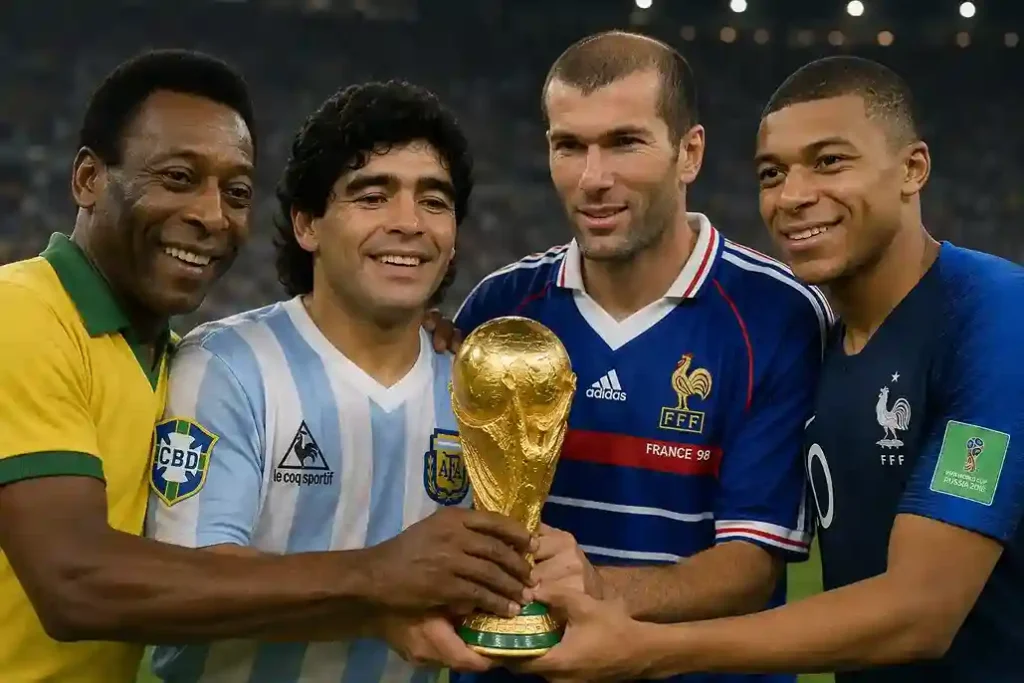
FIFA World Cup Champions Ranking
| Rank | Nation | Wins | Finals Appearances | Finals Record | Years Won | Tournament Hosts | Key Stats |
|---|---|---|---|---|---|---|---|
| 1 | Brazil | 5 | 7 | 5W–2L | 1958, 1962, 1970, 1994, 2002 | Sweden, Chile, Mexico, USA, South Korea/Japan | 229 goals scored; 3× consecutive finals appearances (1994–2002); unbeaten streak (1958–1970, 20 matches). |
| 2 | Germany | 4 | 8 | 4W–4L | 1954, 1974, 1990, 2014 | Switzerland, West Germany, Italy, Brazil | 226 goals scored; most World Cup finals appearances (8); seven consecutive semi-finals (2006–2014). |
| 3 | Italy | 4 | 6 | 4W–2L | 1934, 1938, 1982, 2006 | Italy, France, Spain, Germany | 114 goals scored; back-to-back champions (1934 & 1938); ended a 24-year title drought in 2006. |
| 4 | France | 2 | 3 | 2W–1L | 1998, 2018 | France, Russia | 89 goals scored; Mbappé won the final at age 19 (2018); runners-up in 2022. |
| 5 | Argentina | 2 | 5 | 2W–3L | 1978, 1986 | Argentina, Mexico | 91 goals scored; defeated Germany in both championship victories. |
| 6 | England | 1 | 1 | 1W–0L | 1966 | England | 11 goals scored; only World Cup title won at Wembley Stadium. |
| 7 | Spain | 1 | 1 | 1W–0L | 2010 | South Africa | 8 goals scored; average possession 63.5%; defeated the Netherlands in the final. |
| 8 | Uruguay | 2 | 5 | 2W–3L | 1930, 1950 | Uruguay, Brazil | 45 goals scored; inaugural FIFA World Cup champions; unbeaten in the first tournament. |
COUNTDOWN: FIFA WORLD CUP CHAMPIONS
1: BRAZIL (5 CHAMPIONSHIPS, 7 FINALS)
Championships: 1958 (Sweden), 1962 (Chile), 1970 (Mexico), 1994 (USA), 2002 (South Korea/Japan)
Brazil remains the gold standard of World Cup success. Their five titles span across six decades, marking unmatched consistency at sport’s highest level. The 1970 campaign in Mexico remains the quintessential World Cup performance—a fluid, attacking style featuring Pelé, Jairzinho, and Carlos Alberto that mesmerized global audiences and set the blueprint for attacking football. The 1994 USA World Cup showcased a different Brazil: pragmatic, defensively sound, anchored by goalkeeper Taffarel and Dunga’s midfield discipline. That tournament ended a 24-year title drought and proved Brazil could adapt to modern, defensive-minded football.
Major titles won by Brazil:
- 1958: Defeated Sweden 5–2 in final; Pelé (age 17) youngest-ever World Cup winner
- 1962: Won without Pelé (injury); defeated Czechoslovakia 3–1; tactical flexibility displayed
- 1970: Defeated Italy 4–1 in final; best-attacking tournament (3.5 goals/match average)
- 1994: Defeated Italy on penalties after 0–0 draw; Romário and Ronaldo spearheaded attack
- 2002: Defeated Germany 2–0 in final; Ronaldo’s two goals sealed victory; returned to attacking flair
Signature Statistics:
- Total World Cup goals: 229 (most of any nation)
- Finals appearance rate: 7 of 24 tournaments (29%)
- Unbeaten streak: 20 consecutive matches (1958–1970)
- Average goals per match: 2.84 (highest among top 5 champions)
2: GERMANY (4 CHAMPIONSHIPS, 8 FINALS)
Championships: 1954 (Switzerland), 1974 (West Germany), 1990 (Italy), 2014 (Brazil)
Germany (including West Germany’s era) represents football’s most competitive edge. Eight final appearances in 24 tournaments equals a 33% finals rate—unmatched consistency. The 1954 Swiss miracle saw West Germany defeat Hungary’s dominant “Magical Magyars” 3–2, ending post-war isolation and reigniting national pride. The 1974 victory, orchestrated by Franz Beckenbauer’s “Total Football,” combined European tactical sophistication with German precision. Their 1990 reunification victory over Argentina embodied the symbolic power of sport; the 2014 Brazil campaign showcased ruthless efficiency (7–1 demolition of hosts in semi-final, 1–0 victory over Argentina).
Major titles won by Germany:
- 1954: Defeated Hungary 3–2; “Miracle of Bern”; ending of post-WWII sports isolation
- 1974: Defeated Netherlands 2–1; introduced “Total Football” to world audience
- 1990: Defeated Argentina 1–0; Cold War reunion narrative; Beckenbauer as manager
- 2014: Defeated Argentina 1–0 after extra time; most efficient tournament (goals conceded: 4 in 7 matches)
Signature Statistics:
- Total World Cup finals: 8 (most of any nation)
- Consecutive semi-finals: 7 (2006–2014)
- Goals conceded in 2014: 4 (defensive mastery)
- Average goals per match: 2.45
3: ITALY (4 CHAMPIONSHIPS, 6 FINALS)
Championships: 1934 (Italy), 1938 (France), 1982 (Spain), 2006 (Germany)
Italy’s four championships emerged across vastly different eras, each reflecting the nation’s evolving tactical philosophy. The 1934 and 1938 victories occurred under fascism, with Mussolini leveraging sport for propaganda—yet the football itself introduced the defensive “Catenaccio” system that would define European football for decades. The 1982 Spain triumph, led by Paolo Rossi’s six-goal tournament haul, showcased defensive resilience (eliminated Brazil in iconic second-round match; allowed only 2 goals in 7 matches). The 2006 German victory represented Fabio Cannavaro’s redemption after match-fixing scandals, and Gianluigi Buffon’s goalkeeper mastery.
Major titles won by Italy:
- 1934: Defeated Czechoslovakia 2–1; inaugural tournament hosted in Italy; Catenaccio era begins
- 1938: Defeated Hungary 4–2; only undefeated champions alongside 1982 campaign
- 1982: Defeated West Germany 3–1 in final; Paolo Rossi’s 6 goals; Buffon not yet born
- 2006: Defeated France on penalties after 1–1 draw; Buffon’s 23-match unbeaten streak; Cannavaro captaincy
Signature Statistics:
- Undefeated championships: 2 (1938, 1982)
- Lowest goals conceded in undefeated run: 2 goals (7 matches, 1982)
- Finals appearances: 6 (2nd-most after Germany’s 8)
- Paolo Rossi tournament goals: 6 (1982)—3rd-most in single World Cup
4: FRANCE (2 CHAMPIONSHIPS, 3 FINALS)
Championships: 1998 (France), 2018 (Russia)
France’s two titles bookend the modern era of European dominance. The 1998 home World Cup victory orchestrated by Didier Drogba’s emerging talent and Zinedine Zidane’s headbutt goal in the final symbolized Les Bleus’ arrival at global superpower status—the first European team to win at home since 1974. The 2018 Russia campaign proved France could adapt to modern tournament football: a younger, faster, more athletic squad led by Mbappé (19 years old, youngest player in final since Pelé) and Griezmann’s versatility.
Major titles won by France:
- 1998: Defeated Brazil 3–0 in final at Stade de France; Zidane’s two headers; home advantage decisive
- 2018: Defeated Croatia 4–2 in final in Russia; Mbappé youngest finalist since Pelé (1958); counter-attacking dominance
Signature Statistics:
- Home World Cup victory rate: 100% (won both tournaments hosted in France: 1938, 1998—shared with Uruguay and Brazil)
- Mbappé goals in 2018: 4 (joint-highest young player tally in single tournament after Pelé)
- Finals appearance span: 20 years (1998–2018)
- Third-place finishes: 1 (2022)
5: ARGENTINA (2 CHAMPIONSHIPS, 5 FINALS)
Championships: 1978 (Argentina), 1986 (Mexico)
Argentina’s two titles reflect South American football’s golden era. The 1978 home victory under Daniel Passarella’s captaincy showcased tango-like passing, tactical flexibility, and the emerging genius of Diego Maradona (age 17). The 1986 Mexico campaign remains Maradona’s singular masterpiece—he orchestrated all five of Argentina’s goals in the final against West Germany, setting up the winning goal with a killer pass to Jorge Buruchaga. No single player has dominated a World Cup more completely than Maradona in 1986.
Major titles won by Argentina:
- 1978: Defeated Netherlands 3–1 after extra time in final; home advantage; Passarella’s leadership
- 1986: Defeated West Germany 3–2 in final; Maradona’s tournament-best 5 assists; “Hand of God” goal vs. England in quarter-finals (controversial); 34 total goals scored
Signature Statistics:
- Maradona’s 1986 tournament: 5 goals, 5 assists (only player to lead tournament in both categories)
- Finals appearances: 5 (joint-2nd with Italy and Germany)
- Goals scored in finals: 6 (1978: 3 + 1986: 3)
- Home World Cup record: 1W–0L (only defeated once at home: 1930 final vs. Uruguay)
6: ENGLAND (1 CHAMPIONSHIP, 1 FINAL)
Championships: 1966 (England)
England’s sole World Cup victory at home in 1966 remains the nation’s defining sporting moment. Playing at Wembley, England defeated West Germany 4–2 after extra time in a match that defined modern football—controversial third and fourth English goals in extra time sparked debates lasting decades. Bobby Charlton, Bobby Moore, and Geoff Hurst (hat-trick in final) became household names. The tournament showcased England’s emerging status as a European power, though subsequent campaigns never replicated that success.
Major titles won by England:
- 1966: Defeated West Germany 4–2 at Wembley; Geoff Hurst’s hat-trick in final; 11 total goals scored in 6 matches (1.83 avg)
Signature Statistics:
- Home advantage decisive: Only World Cup victory at home
- Geoff Hurst’s final goals: 3 (only player with hat-trick in World Cup final)
- Finals appearances: 1 (lowest among all champions—never reached final again)
- Post-championship drought: 58 years (1966–2024) without another final appearance
7: SPAIN (1 CHAMPIONSHIP, 1 FINAL)
Championships: 2010 (South Africa)
Spain’s 2010 victory represented a tactical revolution. Under Vicente del Bosque, Spain pioneered “tiki-taka”—a possession-based, short-passing style that dominated midfield and controlled match tempo. Averaging 63.5% possession, Spain suffocated opponents through ball retention and one-touch passing. The final against Netherlands showcased this dominance: a 1–0 victory that seemed anticlimatic given Spain’s overwhelming superiority. This tournament influenced football globally; nearly every national team subsequently attempted possession-based systems.
Major titles won by Spain:
- 2010: Defeated Netherlands 1–0 in final at South Africa; possession-based dominance (63.5% avg); Andrés Iniesta’s extra-time winner
Signature Statistics:
- Possession average: 63.5% (highest in World Cup history among champions)
- Goals conceded: 2 (7 matches); defensive solidity despite attacking focus
- Passing accuracy: 88.4% (tournament average)
- Finals appearances: 1 (never reached final before or since)
- Tiki-taka influence: Global tactical shift following 2010 model
8: URUGUAY (2 CHAMPIONSHIPS, 5 FINALS)
Championships: 1930 (Uruguay), 1950 (Brazil)
Uruguay, the inaugural World Cup champion, claimed the tournament’s most unexpected achievement. As the smallest nation ever to win (population 2.7 million), Uruguay defeated Argentina 4–2 in the 1930 final at home soil. Remarkably, they returned as champions in 1950—a 20-year gap between titles, during which global football evolved dramatically. The 1950 “Maracanã” tournament (held in Brazil) saw Uruguay upset favored Brazil in the semi-final-style group phase decider, claiming their second title.
Major titles won by Uruguay:
- 1930: Defeated Argentina 4–2 in final; smallest population champion ever; home-advantage decisive
- 1950: Defeated Brazil 2–1 in Maracanã final decider; shock victory over tournament hosts; Alcides Ghiggia’s match-winner
Signature Statistics:
- Finals appearances: 5 (tied with Argentina and Germany’s pre-modern era record)
- Unbeaten 1930 tournament: Only nation to win World Cup without dropping a match
- 20-year title gap (longest between championships for any multi-champion nation)
- Population at 1930 victory: 2.7 million (smallest nation to win until modern era)
HONORABLE MENTIONS
- Netherlands (3 Finals, 0 Championships): Finalist in 1974, 1978, 2010. Never won despite reaching finals thrice—record for runners-up.
- Hungary (Olympic Champion, No World Cup Title): Reached 1954 final but lost to West Germany. “Magical Magyars” dominated early 1950s but never captured World Cup.
- Sweden (Semi-finalist, Host Advantage): Reached 1950 final but lost to Uruguay. Only reached final once as host (1958 saw Brazil win; 1994 saw USA host).
- Portugal (Semi-finalist, Modern Era Finalists): Reached semi-finals 1966 and 2014. Third-place finish in 2022 Qatar World Cup.
- Belgium (Semi-finalist): 2018 semi-final exit after reaching quarter-finals (2014). “Golden Generation” (De Bruyne, Hazard, Courtois) never won title despite hype.
Suggested Reads:
- How to Be a Goalkeeper for Beginners: Skills, Saves, and Rules
- How to Become a Professional Footballer