
If you’ve ever watched a football match with someone new to the sport, you already know: offside is the rule that breaks their brain first. It’s not that the rule itself is especially complicated — it’s that it happens in a split second, involves multiple players at once, and the explanation everyone gives (“he was in front of the last defender”) usually raises more questions than it answers.
So let’s actually break it down properly — what the rule says, why it exists, the exceptions nobody tells you about, and how the new officiating technology at the 2026 World Cup has changed how these decisions get made in real time.
What Is the Offside Rule, In Plain English?
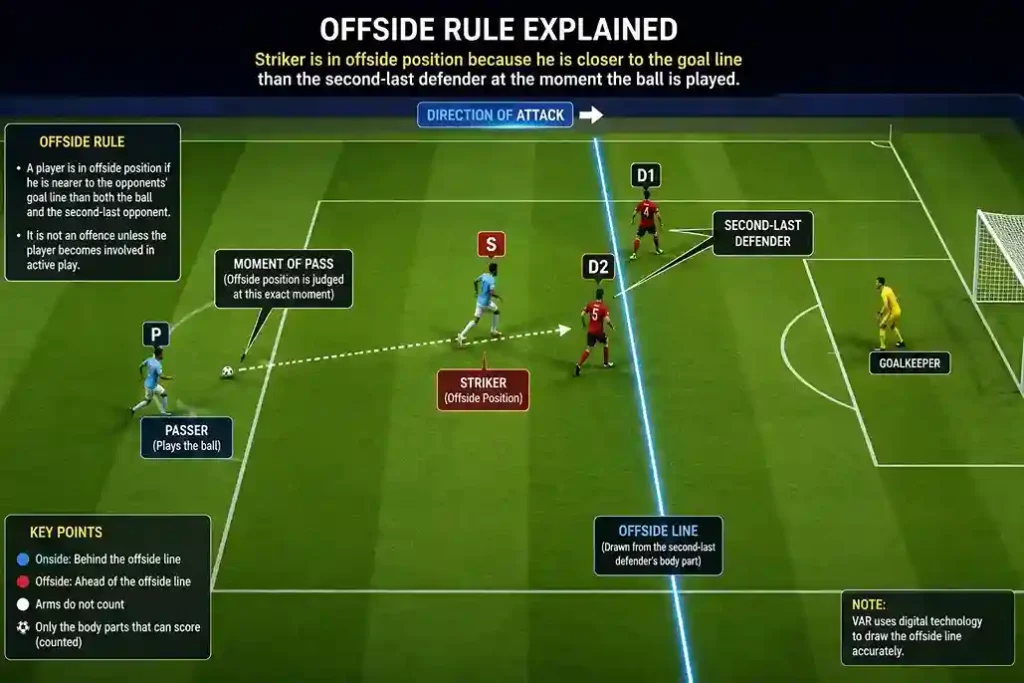
At its simplest: a player is offside if they’re standing in the opponent’s half, closer to the opponent’s goal line than both the ball and the second-last opponent, at the exact moment the ball is played to them.
That’s it. But nearly every word in that sentence matters, so let’s unpack it piece by piece.
⚽ The Two Conditions That Must Both Be True
Understanding the Offside Rule in Football
① Position
The player must be in the opponent’s half and closer to the opponent’s goal line than both the ball and the second-last opponent. The second-last opponent is often, but not always, the goalkeeper.
② Involvement
The player must then become actively involved in play by touching the ball, interfering with an opponent, or gaining an advantage from that offside position.
💡 Important Note
Being in an offside position alone is not an offense. A player is penalized only when both conditions are met: being in an offside position and actively becoming involved in play. This is the point many casual fans misunderstand — a player can stand in an offside position without committing an offense until they become involved in the play.
When You Are NOT Offside (The Exceptions)
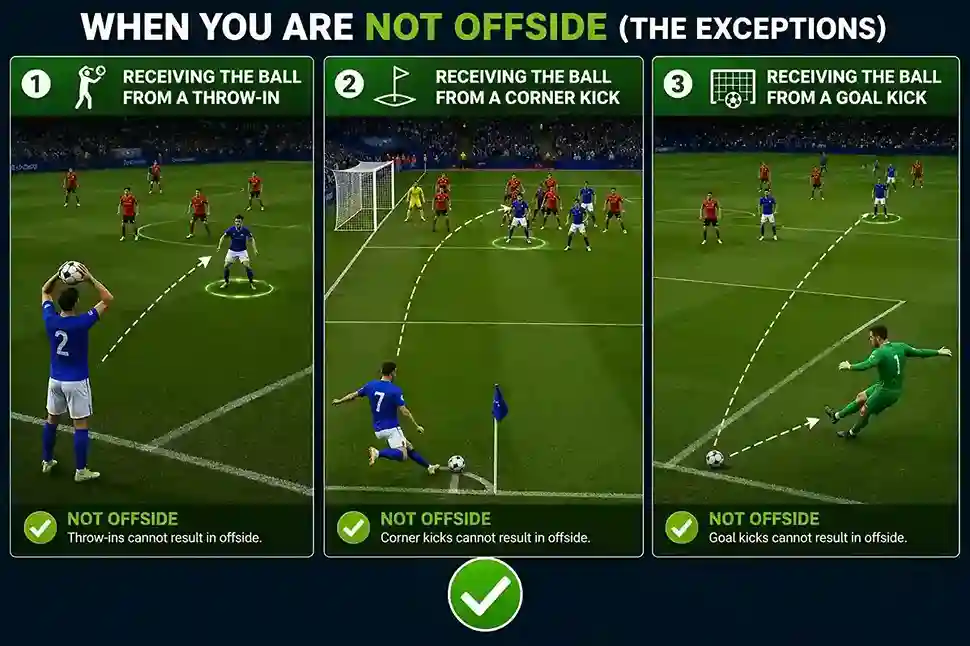
This is where most of the confusion actually lives. A player cannot be penalized for offside in any of these situations:
- Receiving the ball directly from a goal kick.
- Receiving the ball directly from a throw-in.
- Receiving the ball directly from a corner kick.
- Standing in their own half of the pitch, no matter how far forward the rest of their team is positioned.
- Being level with the second-last defender (or the ball) rather than genuinely ahead of them — “level” is onside, not offside.
That last point trips up a lot of viewers watching a tight offside replay: if any part of the attacker’s body that can legally score a goal (so, not their hand or arm) is level with or behind the last defender, it’s an onside call, not offside.
A Simple Walkthrough Example
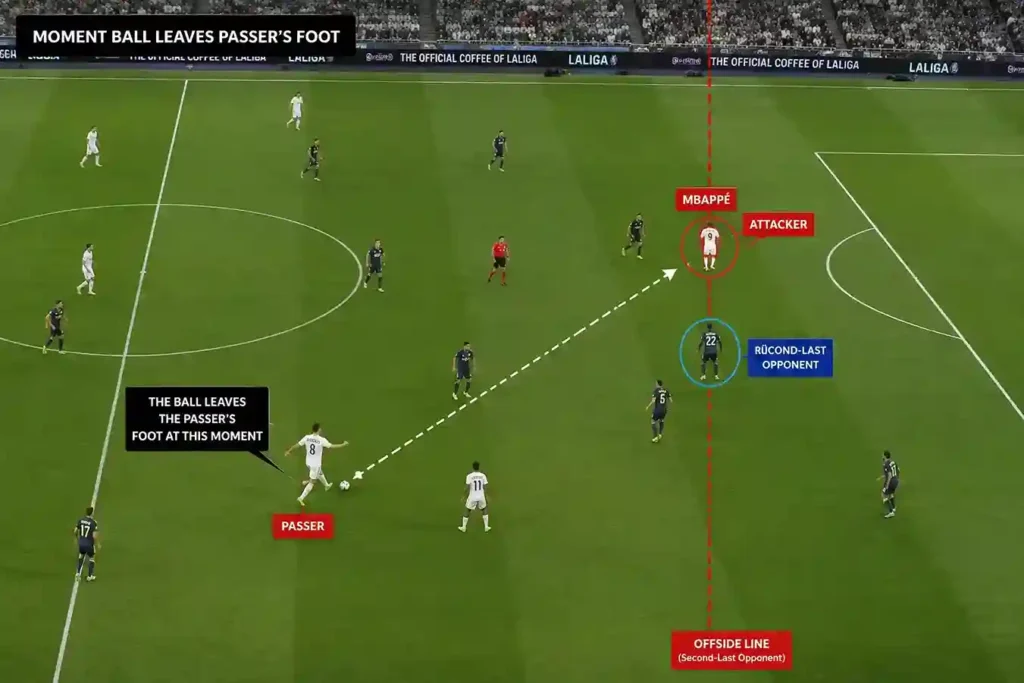
Picture this: a striker starts a run just inside the opponent’s half. As the pass is played, freeze the moment the ball leaves the passer’s foot — not when the striker receives it. If, at that exact instant, the striker’s body is closer to the goal line than both the ball and the second-last defender, and they then go on to touch the ball or clearly affect play, it’s offside. If the striker timed the run so they were level with the last defender at that moment, it’s a perfectly legal goal.
This is also why “the moment the ball is played” matters so much — a player can time a run to be onside at the exact second of the pass, then sprint past the defender afterward completely legally. That’s not a loophole; it’s the entire point of a well-timed offside run, and it’s one of the more beautiful tactical elements of the sport once you can actually see it happening.
How Modern Technology Changed Offside Calls
Offside decisions used to rely on assistant referees making split-second judgment calls from the touchline, and then, after 2022, on video assistant referees manually drawing lines across a broadcast freeze-frame. Both approaches were slow and occasionally controversial.
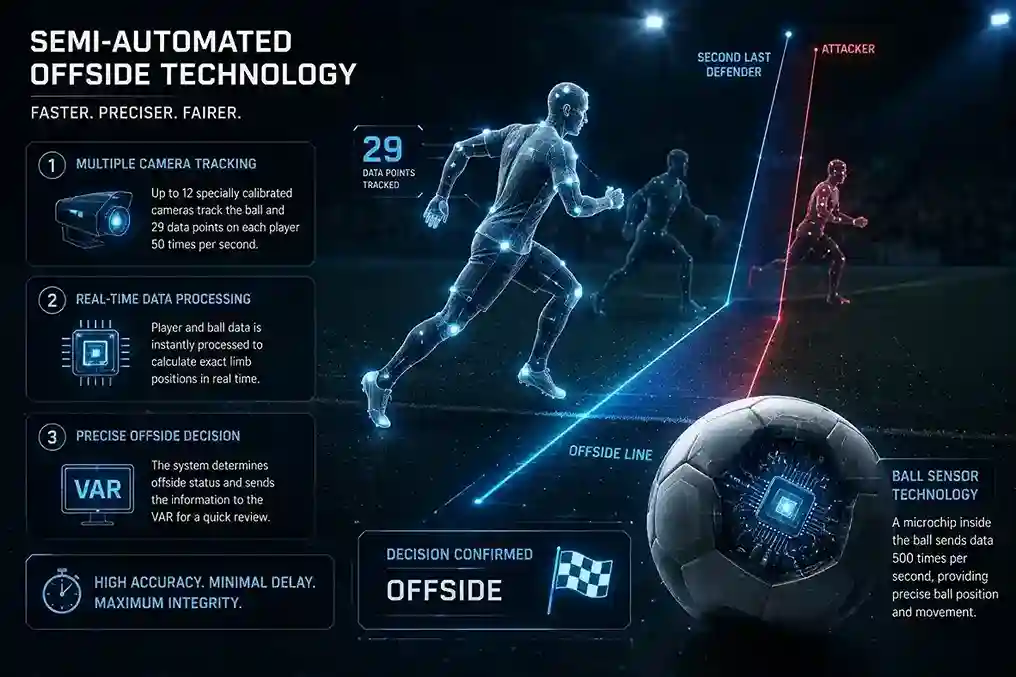
For the 2026 World Cup, FIFA introduced an upgraded semi-automated offside system that changes this significantly. The technology builds a 3D avatar of every single player at the tournament, tracks limb and ball positions in real time through a combination of cameras and ball-sensor data, and sends an instant audio alert directly to the match officials the moment a player is judged clearly offside beyond a small tolerance threshold. Where earlier systems still required a manual video review to confirm a borderline call, the 2026 version resolves many decisions in seconds rather than minutes.
Why the Goalkeeper Rule Still Trips People Up
Even with all that technology, one specific detail of the offside law keeps catching players and fans off guard: the “second-last opponent” doesn’t have to be an outfield defender — it’s whichever two opposing players are closest to their own goal line, and that frequently includes the goalkeeper. If a goalkeeper rushes off their line to close down an attack and ends up out of position, they can effectively stop counting as one of the two players an attacker needs to stay behind, which can turn what looks like an onside position into an offside one. This exact scenario became a major talking point during the 2026 tournament’s group stage, when a disallowed goal hinged on precisely this technicality — a reminder that even instant, sensor-driven technology is still applying a law written for a much more analog era of the sport.
A Brief History of the Offside Rule (How We Got Here)
Understanding where this rule came from actually makes it much easier to understand why it works the way it does today. Here’s the timeline:
⚽ Evolution of the Offside Rule
Major Changes in Football’s Offside Law (1863–2026)
The Three Official Ways a Player Can Be “Involved in Play”
This is the part that separates a casual fan’s understanding from a genuinely advanced one. Since the 2005 clarification, IFAB’s Laws of the Game define exactly three ways an attacker in an offside position can be penalized:
A player in an offside position actually touches or plays the ball after it has been passed or touched by a teammate.
Blocking an opponent’s line of sight, challenging them for the ball, or making a movement that clearly affects an opponent’s ability to play the ball.
Playing a ball that rebounds or deflects from the goalpost, crossbar, goalkeeper, or another opponent after the player was already in an offside position when the original ball was played.
That third category has an important exception advanced viewers should know: if the ball comes off an opponent’s deliberate save or deliberate play, the offside is judged fresh from that new moment — but if it’s merely a deflection or an instinctive touch that wasn’t a deliberate action, the original offside position still applies. This distinction between a “deliberate play” and a mere “deflection” is one of the most frequently misunderstood parts of the entire law, and it’s exactly the kind of marginal call that VAR reviews are often built around.
The Offside Trap: An Advanced Team Tactic
Because the rule rewards precise timing over raw positioning, defenses have built an entire tactic around it: the offside trap. A defensive line steps forward together, in unison, at the exact moment an opponent plays a forward pass — deliberately leaving an unaware attacker standing offside. Done well, it’s one of the most effective (and risky) defensive tools in football.
The most famous historical example is Johan Cruyff’s Ajax and the Netherlands side of the early-to-mid 1970s, who used a coordinated offside trap as part of “Total Football” to compress space and force turnovers high up the pitch. In the modern game, Diego Simeone’s Atlético Madrid sides have built a similar reputation, using a disciplined, tightly-coordinated back line to draw attackers offside repeatedly and stifle even the most dangerous forwards. The risk, of course, is timing — a defensive line that steps up half a second late doesn’t create an offside trap, it creates a one-on-one with the goalkeeper.
What Might Change Next: The “Daylight Rule” Proposal
Arsène Wenger, now FIFA’s chief of global football development, has continued pushing for what’s commonly called the “daylight” rule — a proposal that would only penalize an attacker if their entire body is ahead of the last defender, rather than just level with them, giving attackers a slightly bigger benefit of the doubt. Early trials in youth competitions have shown mixed results: attackers get more freedom to make risky forward runs, but some analysts worry defensive lines might simply drop deeper in response, potentially canceling out the intended benefit. As of now, the standard Laws of the Game remain unchanged, but this is the proposal most likely to reshape the rule next if it’s ever formally adopted.
Frequently Asked Questions
Understanding the Football Offside Rule