
Watch any cricket match and you’ll hear commentators throw around names like “gully,” “cover,” “silly point,” and “long on” as if everyone already knows exactly where those spots are. For a beginner, it can feel like a different language. This guide breaks down every standard fielding position on a cricket field, what side of the pitch it’s on, and why captains place fielders there.
Off Side vs Leg Side — The Basic Divide
Every fielding position is described relative to the batter. The off side is the side the batter’s chest faces when in their batting stance, and the leg side (or on side) is behind their back. This off/leg split is the foundation for naming almost every position on the field — for example, “cover” is on the off side, while “mid-wicket” is on the leg side.
Positions are also grouped by distance from the pitch:
- Close-in — very near the batter, used to catch fast edges or mistimed shots
- Short / inner ring — inside the 30-yard circle, a mix of run-saving and catching
- Deep / boundary — near the boundary rope, mainly to stop fours and sixes
Full Cricket Fielding Positions Table
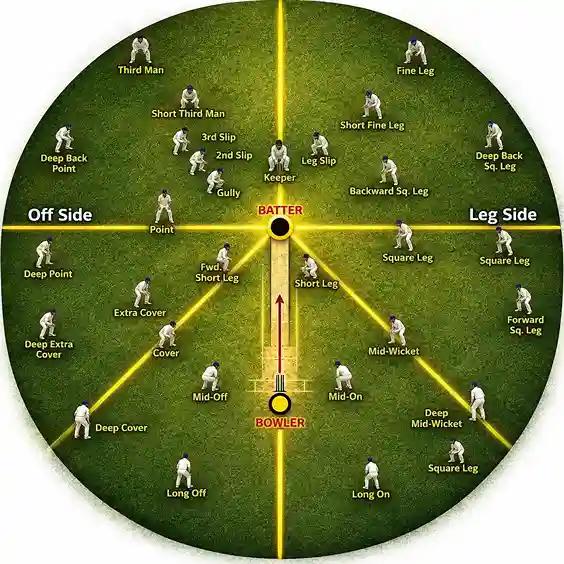
🏏 Cricket Fielding Positions
| Position | Side | Distance | Role |
|---|---|---|---|
| Wicketkeeper | Behind Stumps | Close | Catches, stumpings, run outs |
| Slip (1st, 2nd, 3rd) | Off Side | Close | Catches thin edges off fast bowling |
| Gully | Off Side | Close | Catches uppish edges square of the wicket |
| Point | Off Side | Short | Stops square-cut shots, quick reflexes |
| Backward Point | Off Side | Short | Covers the gap behind point |
| Cover | Off Side | Short | Covers drives through the off side |
| Extra Cover | Off Side | Short | Sits between cover and mid off |
| Mid Off | Off Side | Short | Close to the bowler, stops straight drives |
| Silly Point | Off Side | Very Close | Extremely close catching position, mainly vs spin |
| Short Leg | Leg Side | Very Close | Close catcher for leg-side edges vs spin |
| Leg Slip | Leg Side | Close | Mirrors the slip cordon on the leg side |
| Square Leg | Leg Side | Short | Square of the wicket on the leg side |
| Mid Wicket | Leg Side | Short | Covers leg-side drives and pulls |
| Mid On | Leg Side | Short | Close to the bowler on the leg side |
| Fine Leg | Leg Side | Deep | Behind the batter, stops glances and top edges |
| Third Man | Off Side | Deep | Behind the batter, stops edges run to the boundary |
| Deep Point | Off Side | Deep | Boundary rider for square-of-the-wicket shots |
| Deep Cover | Off Side | Deep | Boundary rider for cover drives |
| Long Off | Off Side | Deep | Boundary rider straight down the ground, off side |
| Long On | Leg Side | Deep | Boundary rider straight down the ground, leg side |
| Deep Mid Wicket | Leg Side | Deep | Boundary rider for leg-side hits |
| Deep Square Leg | Leg Side | Deep | Boundary rider square of the wicket, leg side |
| Cow Corner | Leg Side | Deep | Between deep mid wicket and long on, targeted by big hitters |
Close-In Fielding Positions
Close-in fielders like slip, gully, silly point, leg slip, and short leg stand just a few feet from the bat. These positions are set to catch fast edges or bad-bounce deliveries, and they’re used far more often against spin bowling or on pitches offering extra bounce, since the risk of a firmly hit shot causing injury is much higher against pace.
Off Side Fielding Positions
The off side houses positions like point, cover, extra cover, mid off, and third man. Since most batters are naturally stronger driving through the off side, captains often stack more fielders here in the first half of an innings, especially during the powerplay when boundary riders are limited.
Leg Side Fielding Positions
Leg side positions — square leg, mid wicket, mid on, fine leg, and deep square leg — are set to cover pulls, flicks, and glances. Spin bowlers in particular often ask for a packed leg side field with short leg and leg slip to pressure batters who work the ball off their pads.
How Captains Use the Field
Field placements shift constantly based on the bowler, the batter, the match situation, and the format. A fast bowler attacking early in a Test match might use two or three slips and a gully, while a spinner bowling in the middle overs of an ODI might set a short leg and silly point to attack, backed by fielders saving singles elsewhere. In T20 cricket, captains frequently sacrifice catching positions altogether during non-powerplay overs, spreading fielders to the boundary to cut off big shots, since ODI and T20 powerplay fielding restrictions limit how many players can stay inside the circle.
FAQ: Cricket Fielding Positions
Q. How many fielding positions are there in cricket?
There’s no fixed official number, since fielders can technically stand anywhere within the rules, but around 20–25 named positions are commonly used and recognized across the sport.
Q. What is the most attacking fielding position?
Short leg and silly point are considered the most attacking, since they’re placed extremely close to the bat purely to take catches, accepting real physical risk in exchange for wicket-taking chances.
Q. Why is it called “gully”?
The name comes from the position sitting in the “gully,” or gap, between the slip cordon and point — a narrow passage where thin edges often travel.
Q. What’s the difference between fine leg and long leg?
They refer to the same general area behind square on the leg side; “fine leg” is the traditional name, while “long leg” is more common in modern commentary when the fielder is positioned near the boundary.
Advanced Fielding Positions (Rarer Variations)
Beyond the standard positions, commentators and coaches also use these more specialized terms:
🏏 Additional Cricket Fielding Positions
| Position | Side | Description |
|---|---|---|
| Leg Gully | Leg Side | Mirror of gully on the leg side, used mainly against spin. |
| Backward Short Leg | Leg Side | Very close, slightly behind square, for bat-pad catches off spin. |
| Silly Mid On / Silly Mid Off | Straight | Extremely close catchers near the popping crease, straight of the bat. |
| Short Cover | Off Side | Sits between silly point and cover, closer in than normal cover. |
| Short Fine Leg | Leg Side | Inner-ring version of fine leg, saves the quick single rather than the boundary. |
| Sweeper (Cover / Leg) | Off or Leg Side | Boundary fielder shifted to cut off the sweep shot, common against spin in ODIs and T20s. |
| Cover Point | Off Side | Sits between point and cover. |
| Long Stop | Behind Keeper | Old-fashioned deep position behind the wicketkeeper, rarely used above club level today. |
Fielding Positions on the Clock Face
Coaches and commentators often describe field placements using a clock face, with the batter standing at the center facing 12 o’clock (straight down the pitch):
| Clock Position | Field Position |
|---|---|
| 12 o’clock | Straight down the ground (Long On / Long Off) |
| 3 o’clock | Square of the wicket, off side (Point) |
| 6 o’clock | Directly behind the batter (Third Man / Fine Leg area) |
| 9 o’clock | Square of the wicket, leg side (Square Leg) |
The clock-face method makes it much easier to describe a field change in real time. For example, “moving a fielder from 2 o’clock to 4 o’clock” instantly tells you the fielder shifted from cover toward point.
Common Named Field Settings
Certain field arrangements have their own names because they’re used so often for specific tactical situations:
Attacking Field
Packed with slips, gully, and close catchers, with few or no boundary riders. Typically used with a new ball or a second new ball in Test cricket to create wicket-taking opportunities.
Defensive / Ring Field
Fielders are spread evenly around the inner ring to cut off singles rather than attack. Common through the middle overs of a One Day International (ODI).
Umbrella Field
Multiple close catchers (slip, gully, short leg, silly point, and leg slip) arranged in a semicircle around the batter. Typically used for finger-spinners bowling to a batter playing defensively.
7-2 or 6-3 Field
Shorthand for how fielders are split between the off side and leg side. For example, a 7-2 off-side field means seven fielders are placed on the off side and two on the leg side. Captains use this split to target a batter’s stronger scoring side.
Packed Leg-side Field
Stacking multiple fielders on the leg side, often used against batters who struggle to work the ball through the off side.
Conclusion
Fielding positions aren’t just names on a diagram — every spot on the field reflects a specific tactical purpose, from close-in catchers hunting a wicket to boundary riders cutting off risk. Once you know where positions like gully, cover, and long on actually sit, watching a match’s field placements becomes a window into the captain’s entire game plan.
For more on how these positions interact with the rules of the game, check out our Cricket Rules Explained: The Ultimate Data-Backed Guide.